

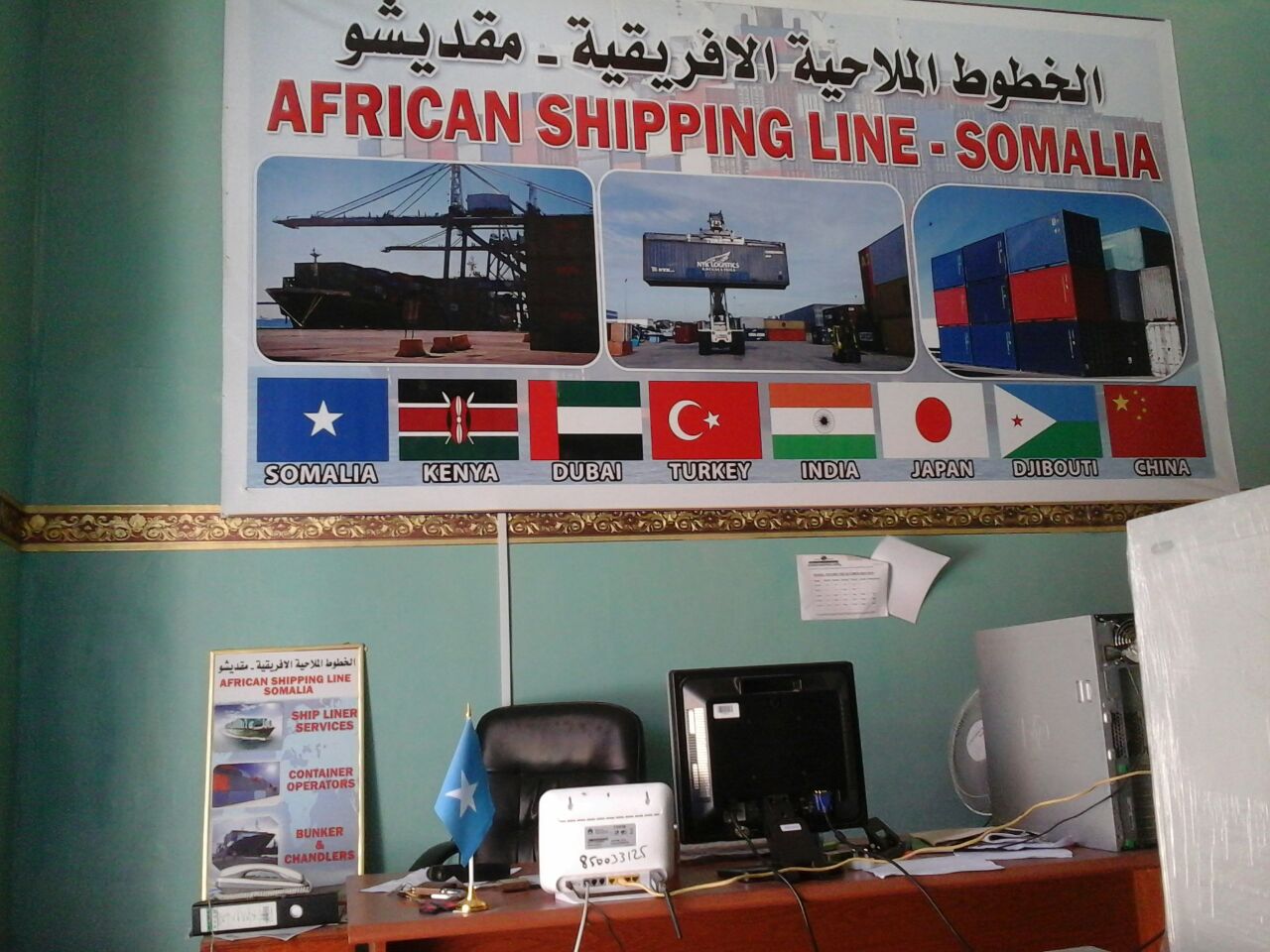
ASLINE - AFRICAN SHIPPING LINE DUBAI

Wednesday
MARITIME SECURITY BOATS ON SALE

We wish to advise that we have couple of Maritime security Patrol boats/vessels for sale, which could be used for offshore Maritime Security along the Kenya-Somalia Basin and other areas.
These Vessels are offered, “subject continued availability”, basis: “as is where is”, {Norwegian Sale Form Agreement}. - NSF Terms. Vessels are currently available prompt inspection/delivery – Europe, to named and qualified buyers only.
Please advise if of serious interest by mail to: africanshippingdubai@gmail.com
Friday
AFRICA - SOUTH EAST ASIA CONTAINER LINES GROWING STRONGER
 |
| African Shipping Line Covered Ports in Middle East, Indian SubContinent and Far East Including China |

AFRICA-ASIA CONTAINER LINES are reported to be doing brisk business even as Africa is opening up to India, Thailand, Singapore, Malaysia, Indonesia and China Markets. This has been attributed by the recent boom in developing countries in Africa accelerating business leads. The commerce between Africa and Asia epitomizes the explosion of South-South trade. These trade flows are driven by the burgeoning middle classes in Asia's emerging economic giants—China and India—whose appetite for Africa's commodities is growing, and by rising economic growth in sub-Saharan Africa (SSA), which is increasing the demand for Asian manufactured goods.
For example, The Africa-China trade represents more than 10 percent of the continent's trade. In value terms, it represents $114 billion--$52 billion in exports and $62 billion in imports. Africa has a trade deficit with China of about $10 billion, according to AfDB's report, Chinese Trade and Investment Activities in Africa.
For China Shipping, Please email: info@ashline.net or China.shipping@africanshippingline.com
Saturday
LIVESTOCK EXPORTS TO MAURITIUS, ARABIAN COUNTRIES FROM KENYA RISES
 UAE Dubai and Mauritius are now some of the biggest Livestock Markets of Kenya after Cattle Bulls numbers increase due to favourable African tropical climate, Kenya Government Reports say,
Kenya already exporting Beef and Livestock products to many countries including Saudi Arabia, UAE, Egypt, Pakistan, Malaysia and Mauritius and much of the Livestock Shipping is being done from the Port of Mombasa Port.
African Shipping Line can arrange with Vessel Owners to provide Livestock services from Kenya's Mombasa port or Mogadishu, Somali to Saudi Arabia, UAE Abudhabi, Dubai, Qatar, Bahrain, Oman at the cheapest rates and faster voyages. email: info@ashline.net
Kenya has secured other new beef and livestock markets in Libya, the Democratic Republic of Congo and Malaysia, opening a new income stream for pastoralists hard hit by recurrent drought and livestock diseases. The Government said the new markets present a major opportunity for both pastoralists and ranchers. Exporters are buying from pastoralists to meet rising demand which ranchers are unable to meet.

Kenya is the only country in the region which can supply Mauritius with its requirements, says a private company awarded a contract to export 7000 animals worth KSh30 million last year. Between 2004 and 2006, according to Ministry of Livestock figures, Kenyan ranchers earned Sh430 millions from meat product exports.
 Kenya and Shipping Line Companies now say that Egypt has also expressed interest in Kenyan Livestock sector imports.
 “We are negotiating with the Egyptian Delegation for Livestock export,” Ibrahim Ahmed, CEO, African Shipping Line, Kenya and Somalia said recently, adding Egypt will however require live animals but not meat exports.
Kenya has a quota of 142,000 metric tonnes of meat which is provided under the African Caribbean Pacific preferential beef export agreement which cannot be accessed due to prevalence of trade sensitive diseases in the country. According to the statistics released by the Livestock Ministry last year, the Middle East alone has a net demand of 122,000 Metric tonnes.
The region was one of the traditional markets in the 1980s when the country could meet international standards. The animals the country is exporting to Mauritius are sourced from ranches and according to authorities, the export permit does not allow the exporter to source animals elsewhere in the country despite the fact that there may be plenty of animals meeting the required fat content. Kenya's Livestock Ministry earlier announced Iran’s intention to venture into local livestock products processing for purpose of serving the export market.
Kenya recently also secured an export deal to Egypt, where 10 tonnes of beef are exported every week. The country is also exporting up to eight tonnes of mutton to Qatar and Dubai weekly. Between March and July, Kenya exported 4,950 cattle to Mauritius, according to statics provided by the Kenya Government. The growing market has already raised the price of livestock for export. Kenya is angling for a slice of the fast growing demand for animal protein in Arab countries as livestock traders seek an alternative market amid drought and squeezed domestic market.

The Livestock ministry said a team of veterinary and other animal specialists from Arabia have been invited into the country to assess livestock quality control system in a move aimed at unlocking the sector’s export potential. That team is poised to endorse Kenya’s production standards and certify that the country’s animal products meet Islamic (halal) conditions.
This could raise exports to Mauritius, United Arabs Emirates, Kuwait, Qatar and Saudi Arabia which have traditionally bought meat and live animals from Kenya. World meat prices have maintained upward trend from 2008, hitting 20-year highs by end of 2010 in some Arab countries as global demand continue to outstrip supply, Food and Agricultural Organisation records show.
“We have not been in a position to take full advantage of this rising demand which at the moment is being stretched by cultural and religious practices because of standards limitations,” said Mr Mohamed Abbas, Kenyan Government.
SRILANKA BUNKER TERMINAL READY

Sri Lanka plans to open a $ 130 million fuel bunkering terminal with a capacity of 82,000 metric tonnes at its new Hambantota port in May, the island nation’s Ports Authority said on Friday. Hambantota, which opened in November, is set to be Sri Lanka’s biggest port once completed and give the Indian Ocean country access to traffic on one of the world’s biggest East-West shipping lanes, located a few kilometres off its southern coast.
“We will start bunkering in May,” Sri Lanka Ports Authority, Chairman Priyath Wickrama, told Reuters.
“Our target is to reach 4 million tonnes storage, with bulk transhipments.” China Exim Bank has loaned $ 77 million toward the cost of the terminal, which the Ports Authority will operate. China has loaned Sri Lanka the bulk of the money to build the $ 1.5 billion port.
The Ports Authority has said China would have no operational role in the bunker terminal, the only part of the port not open to external investment. Sri Lankan bunker firms want the government to open up to the private sector ship fuel supplies at a new port on the south coast close to the main shipping route, officials said.
The market for ship fuel can be expanded as hundreds of vessels daily sail past the new Hambantota port which was opened last November, they said.
The Hemas group has announced it plans to start bunkering operations at Hambantota in May and is buying four bunker barges. The SLPA has said bunkering will not be opened to private suppliers in Hambantota as it wants to keep the business for itself to earn revenue on ship fuel sales to help repay loans from China taken to build the port. But Sri Lankan bunker firms are lobbying for the bunker business to be opened to the private sector, saying increased competition and efficiency will expand the market.
Sri Lanka Shipping, one of the eight licensed bunker suppliers in Colombo port, has already submitted a proposal to the SLPA to sell ship fuel in Hambantota when it invited investments for industries in the new port.
"We submitted a proposal to supply bunkers under port services," said managing director Mohamed Reza. "We're waiting for a response."
Port operators usually do not get involved in supplying ship fuel which is left to the private sector in other ports, he said.
Sri Lanka Shipping, one of the eight licensed bunker suppliers in Colombo port, has already submitted a proposal to the SLPA to sell ship fuel in Hambantota when it invited investments for industries in the new port.
"We submitted a proposal to supply bunkers under port services," said managing director Mohamed Reza. "We're waiting for a response."
Port operators usually do not get involved in supplying ship fuel which is left to the private sector in other ports, he said.
"People have to go in there and invest and start marketing and offer efficient services at competitive prices to build a market."
Bunker sales at Colombo port increased after a private sector monopoly was broken and more suppliers allowed with prices also falling. Another supplier, Lanka IOC, the local unit of Indian Oil Corp., is also eyeing bunkering at Hambantota.
"We're extremely keen to do bunkering at Hambantota," LIOC managing director K R Suresh Kumar said.
"We see a lot of potential as it is a strategic location which can attract ocean going vessels on the East-West shipping route. We've conveyed our interest to the authorities and hope everyone will get an opportunity along with the SLPA."
Suresh Kumar said the SLPA can earn revenue by hiring bunker fuel storage tanks now under construction to the private sector which can do the marketing and selling.
"It is not necessary for the entire marketing of bunkers to be handled by the SLPA. By allowing more players the business can expand."
Irshad Mushin, director of maritime transportation of Hemas group which is expanding investments in shipping, said private bunker firms could use their global networks to attract ships to take bunkers at Hambantota.
"A proper strategic approach to bunkering needs suppliers who have global networks like bunkering in hubs like Singapore, Fujairah and Rotterdam," he said.
"They have long-term contracts with shipping lines with fleets of big vessels like bulk carriers and oil tankers which take on very large volumes of fuel."
Such an approach would help the port to capture a bigger market for ship fuel than attracting casual callers looking to top up on fuel at the closest port while passing the island.
"While the tank farm is being built the possibility or feasibility of using floating storage should be looked at until the farm is completed," Mushin said.
Bunker sales at Colombo port increased after a private sector monopoly was broken and more suppliers allowed with prices also falling. Another supplier, Lanka IOC, the local unit of Indian Oil Corp., is also eyeing bunkering at Hambantota.
"We're extremely keen to do bunkering at Hambantota," LIOC managing director K R Suresh Kumar said.
"We see a lot of potential as it is a strategic location which can attract ocean going vessels on the East-West shipping route. We've conveyed our interest to the authorities and hope everyone will get an opportunity along with the SLPA."
Suresh Kumar said the SLPA can earn revenue by hiring bunker fuel storage tanks now under construction to the private sector which can do the marketing and selling.
"It is not necessary for the entire marketing of bunkers to be handled by the SLPA. By allowing more players the business can expand."
Irshad Mushin, director of maritime transportation of Hemas group which is expanding investments in shipping, said private bunker firms could use their global networks to attract ships to take bunkers at Hambantota.
"A proper strategic approach to bunkering needs suppliers who have global networks like bunkering in hubs like Singapore, Fujairah and Rotterdam," he said.
"They have long-term contracts with shipping lines with fleets of big vessels like bulk carriers and oil tankers which take on very large volumes of fuel."
Such an approach would help the port to capture a bigger market for ship fuel than attracting casual callers looking to top up on fuel at the closest port while passing the island.
"While the tank farm is being built the possibility or feasibility of using floating storage should be looked at until the farm is completed," Mushin said.
Tuesday
SDV TRANSAMI CONSTRUCTS A DRY PORT AT NAIROBI -KENYA

An SDV Transami inland container depot at Embakasi, Nairobi on the Left.
A dry port terminal being constructed by logistics company SDV Transami is set for completion next month, easing congestion at the Mombasa port and saving traders costs associated with delays. The Port of Mombasa is already under pressure from increased trade in Kenya and neighbours Uganda, Rwanda and Burundi and the Great Lakes region.
“With Kenya’s growing economy, there is need for the Port of Mombasa to become more competitive by increasing its efficiency. The intention is to have the new terminal as a holding ground that will ease congestion there,” said Mr Tony Stenning, the SDV Transami regional managing director.
Since 2000, container traffic at the port has grown eight per cent annually, according to the Kenya Ports Authority (KPA). In 2007, the port handled 585,000 Twenty Foot Equivalent Units (Teus) against an installed capacity of 250,000 Teus. Last year, the port handled over 620,000 Teus.
News of the completion of the Sh700 million terminal comes just weeks after the Kenya Ports Authority invited bids for the extension of berths at Mombasa port to enable the gateway handle larger vessels. Once the work is complete on berths 18 and 19, the port will simultaneously handle three ships measuring 760 metres, managing director Gichiri Ndua said.
Shipping firms have in the recent past been introducing surcharge due to delays at the port, which end up increasing the cost of doing business in Kenya. It is estimated that delays and corruption at the port add up to 30 per cent on consumer prices for imports. As a result, Tanzania has been selling the its facility in Dar es Salaam as an alternative route. A new measure to establish a dry port in Tororo, Uganda could also help ease congestion at the Port of Mombasa. The inland port will quicken cargo clearance at the Mombasa for goods bound for Uganda and the Great Lakes region.
“The port will significantly improve efficiency in cargo handling thereby reducing freight costs and demurrage occasioned by long delays,” said Mr Mohamed Jaffer of Great Lakes Ports.
Monday
HANJIN SHIPPING, UASC (UNITED ARAB SHIPPING COMPANY) INTRODUCE WEST AFRICAN SERVICE

Hanjin Shipping together with UASC (United Arab Shipping Company) have introduced a West Africa Service early this year connecting Africa with Europe ports of Valencia. Hanjin is Korea's largest and one of the world’s top ten container carriers that operates some 60 liner and tramper services around the globe transporting over 100 million tons of cargo annually. Its fleet consists of some 200 containerships, bulk and LNG carriers. Hanjin Shipping has a comprehensive global business network with 4 regional headquarters, 200 overseas branch offices, and 30 local corporations.
Named WAF (West Africa Service), this new service will be running between Valencia, Lagos, Cotonou, Tema and Abidjan with 2 of 1,700TEU class ships, 1 deployed by Hanjin Shipping and the other by UASC.
Hanjin Shipping comments that the introduction of WAF will not only enable the company to expand its presence in Africa, one of the world’s fastest growing markets, but also to better service quality by extending the scope of its service range. In addition, Hanjin Shipping reveals that they are planning to change the calling port from Valencia to Algeciras this coming April, in accordance with the opening of the company’s new dedicated terminal in the region, which is expected to become a new logistics hub in the Mediterranean and West African regions for Hanjin Shipping.
Meanwhile, Hanjin Shipping is continuing to seek opportunities to cooperate with partner carriers in service-launching and more in order to satisfy the various needs of its customers.
WAF (West Africa) Service
Port Rotation: Valencia → Lagos → Cotonou → Tema → Abidjan → Valencia
Vessel Deployed: 1,700TEU X 2 (HJS X 1, UASC X 1)
Named WAF (West Africa Service), this new service will be running between Valencia, Lagos, Cotonou, Tema and Abidjan with 2 of 1,700TEU class ships, 1 deployed by Hanjin Shipping and the other by UASC.
Hanjin Shipping comments that the introduction of WAF will not only enable the company to expand its presence in Africa, one of the world’s fastest growing markets, but also to better service quality by extending the scope of its service range. In addition, Hanjin Shipping reveals that they are planning to change the calling port from Valencia to Algeciras this coming April, in accordance with the opening of the company’s new dedicated terminal in the region, which is expected to become a new logistics hub in the Mediterranean and West African regions for Hanjin Shipping.
Meanwhile, Hanjin Shipping is continuing to seek opportunities to cooperate with partner carriers in service-launching and more in order to satisfy the various needs of its customers.
WAF (West Africa) Service
Port Rotation: Valencia → Lagos → Cotonou → Tema → Abidjan → Valencia
Vessel Deployed: 1,700TEU X 2 (HJS X 1, UASC X 1)
Tuesday
EVERGREEN, OOCL TO LAUNCH SOUTHEAST ASIA-MIDDLE EAST LINER SERVICE

New Asia Africa Container Lines are envisaged everyday as business is booming between Asia and Africa countries even as Evergreen Line, Orient Overseas Container Line (OOCL) have agreed to operate a new joint Southeast Asia-India-Middle East liner service beginning on August 20, 2010.
In The Meantime, AFRICAN SHIPPING LINE in co-ordination with various Lines has initiated a Feeder Service in the Indian Ocean AFRICA CONTAINER FEEDER LINE covering Mombasa, Zanzibar, Pemba, Dar Es Salaam, Mogadishu, Kismayo, Bosaaso, Djibouti, Berbera Ports,
The partners have agreed to operate the AGI service with five 2,700 TEU ships. The Evergreen vessel LT Genova will initiate the service from Laem Chabang departing on August 20. Evergreen, OOCL and Simatech have entered the new service to meet growing trade demand between ASEAN nations, India, Pakistan and the United Arab Emirates. The AGI service will shorten transit times and enhance the shipping network in the region.The ASEAN-Gulf-ISC (AGI) service will have the following port rotation with a 35-day voyage.
Laem Chabang – Singapore – Tanjung Pelepas - Port Klang – Colombo – Jebel Ali – Karachi – Mundra – Colombo – Port Klang – Singapore – Laem Chabang
African Shipping Line at Mombasa-Kenya are Liner Port Agency, Container Agency, Project cargo in Eastern African Ports (Mombasa, Dar Es Salaam, Mogadishu, Djibouti, Berbera Ports, Please email: info@ashline.net or Call Mr. Ibrahim on +254-726-722-226
For more Info : http://www.africanshippingline.com
In The Meantime, AFRICAN SHIPPING LINE in co-ordination with various Lines has initiated a Feeder Service in the Indian Ocean AFRICA CONTAINER FEEDER LINE covering Mombasa, Zanzibar, Pemba, Dar Es Salaam, Mogadishu, Kismayo, Bosaaso, Djibouti, Berbera Ports,
The partners have agreed to operate the AGI service with five 2,700 TEU ships. The Evergreen vessel LT Genova will initiate the service from Laem Chabang departing on August 20. Evergreen, OOCL and Simatech have entered the new service to meet growing trade demand between ASEAN nations, India, Pakistan and the United Arab Emirates. The AGI service will shorten transit times and enhance the shipping network in the region.The ASEAN-Gulf-ISC (AGI) service will have the following port rotation with a 35-day voyage.
Laem Chabang – Singapore – Tanjung Pelepas - Port Klang – Colombo – Jebel Ali – Karachi – Mundra – Colombo – Port Klang – Singapore – Laem Chabang
African Shipping Line at Mombasa-Kenya are Liner Port Agency, Container Agency, Project cargo in Eastern African Ports (Mombasa, Dar Es Salaam, Mogadishu, Djibouti, Berbera Ports, Please email: info@ashline.net or Call Mr. Ibrahim on +254-726-722-226
For more Info : http://www.africanshippingline.com
CHINA KEEN ON INVESTMENT, TRADE AND SHIPPING IN KENYA, TANZANIA & SOMALIA

Kenya is a gateway to East Africa and a key focus of China's trade and economic cooperation with the African continent. The war-free country with stable political situation made Kenya an ideal regional base for Chinese investors to expand their business in Africa.
China has had a long involvement with Africa, going back to the early days of independence movements in the 1960s and before. But the current level and intent of China’s involvement is different. China’s principal interest in the continent is access to natural resources. But it is not its only interest. China’s economic interests are wider. China’s trade with Africa has risen sharply, from $10 billion in 2003 to $20 billion in 2004 and another 50 percent increase is expected in 2005. Chinese goods are flooding African markets, and – not so different from the United States – there has been growing concern in Africa about the effect on local industry. The primary focus is on textiles where the growth of Chinese exports constitutes a double whammy for Africa. Exports of Chinese textiles to Africa are undermining local African industry while the growth of Chinese exports to the United States is shutting down the promising growth of African exports in this field.
The road could provide a route to export Chinese oil from southern Sudan.
Recently, China's CNOOC (0883.HK) spudded a $26 million exploration well in northern Kenya on Wednesday that will be the deepest yet in a country that has searched in vain for commercial oil and gas deposits for decades.
The Boghal-1 well in Block 9 of the Anza Basin is the 32nd drilled in the east African nation, which hopes to capitalise on growing interest in the continent among explorers due to high oil prices and growing energy nationalism elsewhere.
MSC MV CHITRA COLLIDES WITH MV KHALIJIA 2 OFF MUMBAI

The Panamanian-registered container ship MSC Chitra that had Saturday collided with the MV-Khalijia-II, a St. Kitts registered ship, tilts in the Arabian Sea, close to Mumbai, India, Monday, Aug 9, 2010. Indian coast guard ships and helicopters are working to try and contain an oil spill from the dangerously tilting container ship following the collision near Mumbai, a spokesman for India's defense ministry said Monday.
MSC Chitra had collided with MV Khalijia-111, about 10 kms off the Mumbai coast. Oil was leaking from two of the 12 tanks of MSC Chitra which had got damaged due to the collision. The two tanks could together hold 879 tonnes of oil, sources in the Coast Guard said. The accident caused the vessel to run aground and list heavily to one side. The ship had 2,262 tonnes of oil and up to 400 tonnes of it had leaked into the Arabian sea, threatening marine life and ecology along the Mumbai coastline including in the mangroves.

Saturday
TANZANIA PORTS TO IMPROVE SERVICES : TPA

The Dar-es-Salaam port is working on a major upgrade that could get rid of congestion, attract new business and position itself as “the harbour of choice” in the region.
This could see the Mombasa Port, also battling with congestion made worse by the post-election violence, face increased competition for business in the region.
A senior Tanzania Port Authority (TPA) says they have embarked on new strategies that would lead to increased container terminal capacity and the use of inland depots, optimimum use of the terminal capacity within the port and active participation of various stakeholders in the programmes to reduce dwell-time of cargo at the port.
Key long-term measures by the TPA include construction of multi-storey car park to leave space for container handling. This plan, according to Mr Rugaihuruza, is expected to be ready by the end of 2010.The port managers are also planning the construction of a new container terminal at Bagamoyo and two berths.
UGANDA COMISSIONS AN INLAND DRY PORT THROUGH KENYAN GREAT LAKES PORTS

A Kenyan-based, Great Lakes Ports Ltd is setting up a Sh9.6 billion ($120 million) dry port in Tororo, Uganda bordering Malaba in Kenya to cut delays witnessed at the congested Port of Mombasa.
Great Lakes Ports Ltd has an agreement with the Government of Uganda for a 35-year lease from commencement of full operations and 10 years exclusivity licence. The firm is also building a $50 million handling facility at Changamwe, Mombasa where all sea-borne Ugandan goods will be passed through and later fed to the Inland Port at Tororo.
Countries like Rwanda and Congo that use Uganda as a transport route for their imports will also have their goods cleared at Tororo. Lengthy delays, double charges and damages including total loss of cargo at Mombasa port are some of the issues that have been raised by importers.
The reason for delays, they say is bureaucracy, congestion and levying of tariffs due to delays by shipping lines.
It is estimated that the cost of transportation from Mombasa to Kampala is four times more expensive than from Singapore to Mombasa. Usually when traders, for example those from Uganda, which is landlocked, fail to clear their goods from Mombasa, they are auctioned, making them lose outrightly.
The Kenya Ports Authority and Kenya Revenue Authority, on average, auction 600 containers per year. In money terms, it is about Sh12 billion. In terms of vehicles, an average of 900 units are auctioned annually.
Sunday
LIVESTOCK SHIPPING FROM AFRICAN PORTS - KENYA, SOMALIA, DJIBOUTI & ETHIOPIA
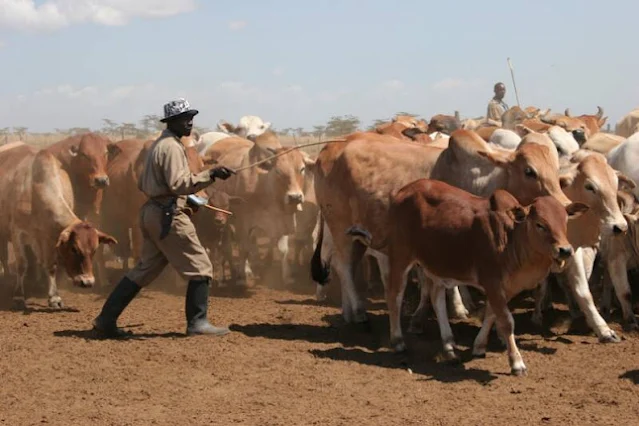

Livestock shipment is not a new way of shipping. Livestock vessel started plying International water even before 1600's. Seagoing vessels modified or purpose-built for the transportation of live animals. This are called Livestock Carriers. But subject to appropriate regulation, live animals may be transported as part of the cargo on various classes of ship. That particular method of transportation is more common on short sea crossings (e.g. ferries) and usually involves relatively small numbers of animals.
Livestock carriers are those ships, which specialize exclusively in the transportation of large numbers of live animals together with their requirements for the voyage. (food, water, sawdust bedding, medication, etc.). Voyages on livestock carriers generally last from three days to three to four weeks.
Livestock shipment from Africa is gaining momentum to countries in the Middle East especially Mauritius, Seychelles, Saudi Arabia, UAE, Qatar and Kuwait. Some other countries like Egypt and Mauritius have high demand for Livestock used for meat processing and export.
Mombasa Port is currently a potential for Livestock shipment. Kenya has a high volume of livestock equivalent to 20 Million animals.
We can get some livestock for you from Africa especially Kenya, Somalia, Djibouti or Tanzania. Please send an email: africanshippingdubai@gmail.com or call/whatsapp +971 56 953 8569 or +254 726 722 226
اغنام صـومـالـي بيع جميع انواع المواشي والأغنام 🐐🐄🐏 جملة & مفرد تصدير إلى جميع دول الخليج العربي للاستفسار اتصل بنا على +971 56 953 8569


Wednesday
INDIA CONTAINER SHIPPING TO MOMBASA(KENYA), MOGADISHU(SOMALIA)

Please be advised that we will be starting only FCL (Full Container Load) for cargo bound for India and Sub Continent specifically for the following destinations:
- Mombasa- Nhava Sheva(Mumbai) Mombasa- Chennai, Mombasa-Colombo.
- NhavaSheva- Mogadishu(Somalia) Through Dubai, Jebel Ali.

Sunday
NOTICE TO TRADE: CLEARING YOUR CARGO AT MOMBASA -KENYA
African Shipping Lines Services Kenya Limited undertakes clearing of Cargo (Containers/ Break-bulk and Vehicles) plus offer for a dedicated transport solution at the Port of Mombasa en-route to the following Local and Transit points:
Kenya,
Uganda,
Tanzania,
South Sudan,
Rwanda,
Burundi
South Ethiopia
Democratic Republic of Congo (DRC)
Kindly be advised that, our professional Customs clearing department will forthwith be handling clearing of all kinds of goods including Foodstuffs (Rice, Sugar, Milk), Textiles, Clothes, shoes, Electronics, perfumes, Travel accesories, cosmetics, Hardware(Spare parts,Machines,Tiles), Furnitures, Tyres, and many more cargo once you submit your Bill of Lading to our staff at our offices. Transport to your doorstep will be provided at costs.
Our office which offers other integrated facilities like Logistics and transport services up to the clients door-step will be ready to serve you.
You can Call Mr. Ibraheem on Mobile +254.726.722226 or Call our office
Kenya,

Uganda,
Tanzania,
South Sudan,
Rwanda,
Burundi
South Ethiopia
Democratic Republic of Congo (DRC)
Kindly be advised that, our professional Customs clearing department will forthwith be handling clearing of all kinds of goods including Foodstuffs (Rice, Sugar, Milk), Textiles, Clothes, shoes, Electronics, perfumes, Travel accesories, cosmetics, Hardware(Spare parts,Machines,Tiles), Furnitures, Tyres, and many more cargo once you submit your Bill of Lading to our staff at our offices. Transport to your doorstep will be provided at costs.
Our office which offers other integrated facilities like Logistics and transport services up to the clients door-step will be ready to serve you.
You can Call Mr. Ibraheem on Mobile +254.726.722226 or Call our office
Email: asline@africanshippingline.ae or africanshippingdubai@gmail.com
MOL ANNOUNCES NEW INDIAN BOUND ROUTES

Mitsui OSK Lines (MOL), the Japanese owned container shipping line have announced more changes to their schedules. This time they have called the new route “SMX” and the service will run on a loop between Laem Chabang, Singapore, Port Kelang, and Chennai with the inaugural sailing of the 162 metre 18,000 DWT vessel MOL Evolution on the 23rd March from the Thai port.
MOL have been thorough in reassessing their sailing schedules in the light of particularly difficult times for the container shipping industry and believe that the SMX route will enable customers to use the network to offer a wide variety of both inbound and outbound services to meet rising demands in this region which the company has said it feels to be a major developing market.
The SMX service rotation will be:
Laem Chabang (Tue, Wed), Singapore (Fri, Sat), Port Kelang (Sun, Mon), Chennai (Fri, Sat), Penang (Wed, Thur), Port Kelang (Thur, Fri), Singapore (Sat, Sun), Laem Chabang
Subscribe to:
Posts (Atom)