الخطوط الملاحية الأفريقية ASLINE - AFRICAN SHIPPING LINE - The World's Gateway to Africa...بوابة العالم إلى الموانئ الأفريقية ...Dünyanın Afrika Limanlarına Açılan Kapısı...世界通往非洲港口的门户......WEEKLY VOYAGES CONNECTING CHINA, MALAYSIA, THAILAND, INDIA, SRILANKA, PAKISTAN, DUBAI TO THE FOLLOWING AFRICAN PORTS : #MOMBASA #DARESALAAM #MOGADISHU #KISMAYO #BOSASO #BERBERA #DJIBOUTI #PORTSUDAN #NACALA #DURBAN #LUANDA #LOBITO #DOUALA #APAPA #TINCAN #LOME #TEMA #ABIDJAN #BISSAU #DAKAR

ASLINE - AFRICAN SHIPPING LINE DUBAI

Friday

KENYAN GOVERNMENT: MOMBASA PORT - SHIPPING & CARGO CLEARANCE TO BE HARMONIZED


Kenya moves to harmonise cargo clearance at sea port

The government has harmonised offloading and clearance of imported goods at the port of Mombasa to curb delays. Maritime and Shipping Affairs Principal Secretary, Nancy Karigithu, said the State wants to clear obstructions in clearance of cargo and reduce bureaucracy in handling of ships. Public and private sector agencies involved in ship, cargo, crew and passenger clearance are to link up with the Single Window System, she said. 

HAPAG-LLOYD TO CONNECT DUBAI TO EAST AFRICA (EAS)

Hapag-Lloyd connects Middle East and East Africa with weekly service. Hapag-Lloyd is a multinational German-based transportation company. It is composed of a cargo container shipping line, Hapag-Lloyd AG, which in turn owns other subsidiaries such as Hapag-Lloyd Cruises.


Starting April 2018, Hapag-Lloyd will launch a new weekly service between the Saudi Arabian port of Jeddah and the east coast of Africa. With the East Africa Service (EAS), the liner shipping company will be calling at the ports of Mombasa (Kenya) and Dar es Salaam (Tanzania) for the first time. These will be connected to Hapag-Lloyd’s existing global network via the Saudi Arabian port of Jeddah, as the central hub of the region. Hapag-Lloyd will initially deploy four vessels, each with a capacity of 1,200 TEU, in the EAS.

The fast-growing economies of countries in East Africa further inland from Kenya and Tanzania, which lack their own seaports, are also likely to benefit from this new offer, as it will give them improved access to the global market. Via the EAS, Uganda, South Sudan, Rwanda, Burundi, the Democratic Republic of Congo, Malawi and Zambia will gain direct access to markets worldwide.

“With our EAS, we will be entering a trade which our customers have wanted us to serve. In the process, the EAS will benefit from Hapag-Lloyd’s strong presence in the Middle East and connect to our global network,” said Lars Christiansen, senior managing director region the Middle East. By selecting Jeddah as the main transhipment port, Christiansen added, Hapag-Lloyd can offer especially fast transit times significantly below those of its competitors.

 The first sailing in the EAS from Jeddah is planned for early April. The port rotation will be Jeddah – Mombasa – Dar es Salaam – Jeddah. Hapag-Lloyd will operate its East Africa Service in an entirely independent manner, without other shipping companies as partners.


Tuesday

MILAHA ACQUIRES IT'S LARGEST CONTAINER VESSEL : MAJD

Milaha has acquired its largest container vessel to date, Majd, a 3,768 TEU vessel. The 3,768 teu, Majd is set to join the Qatar company in the coming weeks as its containership fleet swells to 17 vessels.

The new vessel will be one of the 17 container vessels that the group operates, and is part of the ongoing expansion of the group’s overall fleet. Milaha currently fully owns and operates a fleet of over 80 vessels, including LNG and product tankers, offshore support vessels, container and bulk vessels, among other vessel categories.


Commenting on the new acquisition, Milaha’s President and CEO Mr. Abdulrahman Essa Al-Mannai said: “We are pleased to add Majd to our growing fleet in the few coming weeks. The new vessel is part of our strategy to optimize our container shipping network with larger tonnage to meet increasing customer demand for capacity and cost efficiency in a highly competitive market. Majd will be phased into our existing network and will gradually replace smaller tonnage.”

​Majd was built by STX Shipbuilding Co. Ltd. in South Korea, and has a length overall (LOA) of 246.87 m and a deadweight of 44,985 metric tonnes.As it continues the expansion of its boxshipping services Milaha has acquired its largest container vessel to date.

Milaha has undertaken a major expansion of its container shipping services after Qatar came under sanctions from the UAE, Saudi Arabia, Bahrain and Egypt last year.

SOMALIA BASIN NOW DECLARED RISK FREE FROM PIRACY

NATO has ended Operation Ocean Shield after a sharp drop-off in attacks by Somali pirates. The Royal Danish Air Force carried out the last Indian Ocean surveillance missions for NATO.

Somalia Basin Now Declared Piracy Free Area
The NATO operation had been one part of a highly successful coordinated international response to the threat of Somalia piracy that also included the European Union, the United States and other independent nations.

During its peak, piracy off the Horn of Africa had an economic impact of $7 billion, with more than 1,000 hostages taken. There hasn’t been a successful piracy attack since 2012, down from more than 30 ships at the peak in 2010-11. The NATO planes flew from the Seychelles.

“They have been giving a lot of assistance to us regarding the piracy issue,” said Colonel Simon Dine, a commander with the Seychelles Coast Guard. “They assist us in training with the Seychelles Coast Guard and the Seychelles People’s Air Force, which has given us a great help to assist in the maintaining of the security of the Seychelles’ territorial water. It’s sad for them to go back, but we are looking forward to continue to work with good relationship for the future.”

The commander of the Danish air force detachment that carried out the last mission emphasized that NATO can resume its anti-piracy efforts at any time - whether in the Somali basin or the Atlantic Ocean.

NATO is now shifting resources to deterring Russia in the Black Sea and people smugglers in the Mediterranean.

Courtesy VOA
NATO's spokesman Dylan White said in a statement that the global security environment had changed dramatically in the last few years and that NATO navies had adapted with it.

After more than a decade of NATO-led operations far beyond its borders, the military alliance is shifting its focus to deter Russia in the east, following Moscow's 2014 annexation of Ukraine's Crimea peninsula.


Earlier this month, NATO broadened its operations in the Mediterranean to help the European Union stop criminals trafficking refugees from North Africa.

Friday

SHANGHAI AUTOMATED CONTAINER PORT NOW OPERATIONAL

The construction site of the fourth phrase of the construction of Shanghai International Shipping Center's Yangshan Deep-Water Port, July 9, 2017. [Photo/VCG] 

The world's largest automated port in terms of both scale and size is expected to become operational in Shanghai on Dec 10, according to a report by hket.com on Monday.

The fourth phrase of the construction of Shanghai International Shipping Center's Yangshan Deep-Water Port has nearly reached completion and now equipment are being installed and tested for debugging, the report said.

It is designed to handle 4 million standard containers per year in the near future and 6.3 million in the long term. The port will be able to accommodate the world's heaviest ships. Compared with other ports, its distinctiveness is that automation equipment and control system will be used on such a scale in a port for the first time. The loading and unloading of containers will all be controlled by computers and transported by driverless vehicles.

Zhang Bin, the general director of the port's construction, said the automation equipment can load 25 containers per hour. The core technology of the robotic port was developed independently by China.

The forth phrase of Yangshan port takes up an area of 2.23 million square meters, whose coastline stretches as long as 2,350 meters. It consists of two 70,000 DWT berths and five 50,000 DWT berths.

Friday

SIERRALEONE FREETOWN CONTAINER TERMINAL EXPANSION: USD 120M

Bollore Transport and Logistics a renowned port handler in France with branches across the globe, has completed over 50% of the current works on the 270m container terminal extension at the Queen Elizabeth II Quay in Freetown.

At a depth of 13m, plus 707m, to a depth, forming a central of 3.5 hectares, the Freetown Container Terminal extension works commenced marginally over a year ago, with funds from Bollore Ports, a sub-division of Bollore Transport and Logistics and will be fully completed in September 2018.


The $120 million investment is in sync with government’s development aspirations to transform the Queen Elizabeth II Quay into a large state-of the art transhipment hub in West Africa, create job opportunities, raise the port’s level of income and revenue generation, install cranes, erect a new 27m berth, two ship terminal shores, improve port service delivery capacity to accommodate over six thousand container vessels, host deep sea ships, and above all tap into the potentials for sustainable economic growth of Sierra Leone.

With the highest level of commitments being demonstrated so far by the management, Bollore Transport and Logistics is presently making substantial contribution towards the socio-economic development of Sierra Leone, through diverse means coupled with the continuing extension of the Freetown Container Terminal, directly employing well over 200 Sierra Leoneans as stipulated in the country’s local content policy.

She disclosed that when finally completed, the Freetown Container Terminal will be of the same standard as ports in Conakry, Dakar, and Accra; and will be 24 hours – 365 days operational as a trans-shipment hub with landing, loading and unloading uninterrupted, to meet international demands in the entire sub-region. President Ernest Bai Koroma in a statement during the commissioning of the refurbishment work on 14 October, 2016 said the venture is an indication of Sierra Leone’s readiness for business.

Country Manager Bollore Logistics and Transport, Captain Fabjanko Kokan said his company will continue to make the required industrious efforts to meet the timeframe slated for the completion of the Freetown Container Terminal. He said that Bollore is in Sierra Leone to stay, serving as a reliable partner and in full compliance with the local content policy, which is why so many Sierra Leoneans are being employed directly by the company, to work together with experts and other foreign consultants while on the other hand assuring ship owners worldwide to continue to berth at the Freetown Container Terminal as the gateway of the country during humanitarian crisis.


Bollore is a first class integrated logistics network and port handler in Africa with 36 years record of operational experience in Sierra Leone, is working hard to deliver on its mandate to improve international trade, easy movement of vessels in and out of the port.

Source: SierraLeoneTelegraph

Sunday

PIRACY NO MORE BUT CHINA READY TO ESCORT VESSELS ALONG GULF OF ADEN


Although Piracy has finished along Somalia Sea and in Indian Ocean and Red Sea Routes, China will continue to participate in escort missions in the Gulf of Aden and waters off Somalia to protect the international lane, a spokesperson said on Friday.

The comment by Foreign Ministry spokesperson Geng Shuang came as UN Secretary-General Antonio Guterres praised China in a report to the UN Security Council, saying that China's escort missions played an important role in coping with the pirate threat.

China appreciates the UN chief's acknowledgement of China's work and contribution, Geng said at a daily press briefing.


Under the mandate of the UN Security Council, Chinese Navy began to carry out escort missions in the Gulf of Aden and the waters off Somalia in December 2008. Up to July 2017, it has dispatched 26 task force groups, escorted 6,400 Chinese and foreign vessels and warned away more than 3,000 suspected pirate ships, according to Geng.

"China's engagement in international cooperation against Somali pirates has won applause and contributed to international and regional peace and security," said Geng.

Friday

COSCO SHIPPING PREDICTS PROFIT OF USD 410M - BY SEPT 2017


Cosco Shipping Holdings predicts a profit of $410 million for the first three quarters of the year, citing the recovery in volume and higher container rates, according to a statement on the carrier's website. The company reported a $1.4 billion loss for 2016, owing the loss to weaker pricing even as volume for its shipping line increased.

In addition to an improving market, the company said  synergies  from the merger of Cosco and China Shipping Container Lines and the sale of its stake in the Qingdao Qianwan Container Terminal also boosted profitability. Maritime analyst Drewry estimates carriers will post profits of about $5 billion this year after securing higher annual contract rates on the trans-Pacific and Asia-Europe trades.

The positive forecast from Cosco highlights the continued strength of the market even though spot rates slid through most of the peak season despite strong growth in volumes that led industry analysts to predict a six-year high for the global container trade.

Carriers have generally benefited from strong contract rates, though. The effects of carrier consolidation began to emerge this year, with rates in the third quarter about 39 percent higher year over year in the trans-Pacific and Asia-Europe trade lanes, according to Drewry Shpping Consultants.

Data from Container Trades Statistics shows that first-half volume on Asia-Europe grew by 5.3 percent to 7.9 million TEU and continued to increase through August when 1.4 million TEU were moved on the trade, up 4 percent on the same month last year. US imports from Asia, an indicator of the health of the trans-Pacific trade, were up 4.2 percent in the first half to 7.3 million TEU


Despite the increased volume, overcapacity has prevented spot rates from rising. The slide has been most pronounced on the Asia-Europe trade, where carriers continue to add mega-ship capacity. The latest rate from Shanghai to North Europe per TEU has fallen 25.9 percent from July 28, to $714, but is still up 2.1 percent year over year, according to the Shanghai Shipping Exchange’s Shanghai Containerized Freight Index (SCFI). A similar pattern is at play on the Shanghai-Mediterranean trade, with rates down 21.6 percent from July 28 to $692, but still up 19.7 percent from last year.

Hapag-Lloyd CEO Rolf Habben Jansen told JOC’s Container Trade Europe conference in Hamburg that he was “cautiously optimistic”  about the market, pointing out that although the rates have been falling, they remain well above the lows recorded in 2016.

Although current trans-Pacific spot rates are now lower than the same time last year, rates spent the summer and peak season at much higher levels than last year. The SCFI rate per FEU to the US West Coast is down 16.1 percent to $1,414, and the rate to the East Coast is down 17.6 percent to $1,991. The current negative year-over-year comparisons are due to the sudden jump in rates following Hanjin Shipping’s bankruptcy, when shippers were hit with substantial rate hikes of almost 50 percent.

The 2017 to 2018 contracting season in the eastbound Pacific showed a marked improvement over last year, with rates to the West Coast of about $1,200 per FEU for larger customers, and up to about $1,500 per FEU for smaller BCOs. That compares with some rates that were below $800 per FEU the previous year.  Maersk Line, buoyed by improved contract rates in the Asia-Europe trade, reported improved profit in the second quarter, and it expects to continue profitability through the end of the year. Asia-Europe service contracts, which last about three months, are shorter than trans-Pacific contracts, most of which run for one year, beginning on May 1.

AFRICA EXPRESS LINE ORDERS 500 STAR COOL CONTAINERS FROM MAERSK CONTAINER INDUSTRY (MCI)

October 4, 2017: 

Africa Express Line Ltd (AEL) is expanding its refrigerated container fleet with the addition of 500 Star Cool Integrated containers manufactured by Maersk Container Industry (MCI). Star Cool Controlled Atmosphere offers high energy efficiency and effective care of perishables.

Dedicated to the environment and food safety, AEL selected the industry’s only fully integrated refrigerated container and the Star Cool Controlled Atmosphere (CA) technology for its proven high energy efficiency and effective care of the ripening process of perishables. The containers will be deployed to service AEL’s owner, French fruit exporter Compagnie Fruitiere, in routes to and from Europe and West Africa.

“We set out to invest in containers that would protect the high-value produce we transport while saving energy.  After comparative field trials, the controlled atmosphere technology clearly demonstrated its ability to help ensure the produce arrives at its destination in optimal condition. We will also take advantage of the energy-saving applications and remote monitoring capabilities of Star Cool. Not only will they help us optimise operations, but they will also help us stay true to the CSR commitments we share with our owner, Compagnie Fruitiere,” says Mathew Shed, technical director at AEL.


All Star Cool containers will be equipped with modems for remote access to monitor the assets, temperature, atmosphere, and alarms logged in real time in the Star Cool units. To further propel energy performance, AEL will activate the StarConomy reefer control application, which is proven to halve energy use while maintaining the same temperature inside the container, preserving produce quality.

“We have a long-standing relationship with AEL, and we are delighted that they again have chosen to add the most efficient container model. The integrated Star Cool 2017 model provides a whole suite of new efficiency-enhancing features to support the needs of modern container operations – from monitoring and controlling the atmospheric conditions on the inside of the container to digitalised solutions that allow for transparency and expanded data access,” says Soren Johannsen, chief commercial officer, MCI. “

Built-in digitalised solutions

Star Cool reefers feature a combination of built-in digitalised solutions that can be leveraged any time to further support AEL’s efficient service and surveillance of its Star Cool fleet. This includes an energy meter that offers a reliable and precise tool to measure energy use in real time, either manually or via AEL’s full modem coverage.

In addition, Intelligent Trip Inspection (ITI) now comes standard in all Star Cool reefers. ITI provides an enhanced digital inspection system that removes the need for timely and costly pre-trip inspections. ITI provides self-diagnostics that confirm whether the container is ready for the next trip and highlight if steps in the ITI process need further investigation.

Servicing Europe – West Africa routes

To supplement its fleet of specialised reefer vessels, AEL is chartering the new build 2,345 TEU, m/v ‘MIMMI SCHULTE’, equipped with high reefer plug capacity, to carry the new 40-foot high cube Star Cool CA reefers. Delivered directly from MCI’s factory in Qingdao, the maiden voyage will go to West Africa.

Sunday

OMAN SHIPPING TO GET A SECONDHAND CONTAINER SHIP OF 3000TEUS

September 29 - According to the Times of Oman, the Oman Shipping Company (OSC) is looking for secondhand container ships, each with a capacity of 3,000 teu.

The company which is best known for its tanker fleet, has a couple of container liner services.
One, Gulf Express, is operated between the ports of Sohar and Jebel Ali, UAE, and also calls at the ports of Khorfakkan and Sharjah. This service was started in April last year using a multipurpose chartered vessel, which can carry 400 teu and project cargoes.

Its other container shipping service (Oman Express) connects the ports of Jebel Ali, Sohar, Duqm and Salalah and goes back to Jebel Ali.


Monday

CONTAINERS FOR SALE : KENYA, UGANDA & SOMALIA


We once again have Shipping Containers ready for quick sale, in good sea worth condition, OVER 200 Container UNITS AVAILABLE TO CHOOSE FROM.

Total Price in Mombasa: 

20ft = $1600

40ft =$2600 (Transport Not Included)


Total Prices in Nairobi :

20ft = $1800

40ft = $2800 (Transport Not Included)

Total Prices in Kampala : 

20ft = $1700

40ft = $2500 (Transport Not Included)


Reefers

Total Price in Mombasa: 

20ft = $7000

40ft = $8500 (Transport Not Included)


Good discount given for bulk buyers and commissions given for referrals;

Viewing and reserving a container/s with Depot Managers recommended.

Terms of payment = Bank to Bank Transfers with RTGS copy as proof of payment, and you get release order on confirmation of payment, Cheques accepted, but release Order issued upon funds receipt confirmation.


NB; All units, are Ex EU, legally owned, some with valid CSC plates and can be used for export, and sold with Inter-change, and all relevant documents, including, Invoice, receipt, and Condition Report, and we will undertake minor repairs, paint and Cleaning if required.


We also offer, leasing, storage units, and transport at very discounted rate, and Container conversion / Fabrication, to accommodation units, shops, Toilets & washrooms, living quarters, according to customer demand.


(Transport empty containers @ Ksh 50K -Mombasa – Nairobi per truckload). Within Nairobi or around Mombasa possible. 

E-mail: asline@africanshippingline.ae or africanshippingdubai@gmail.com 


Saturday

MSC, YANG MING LAUNCH SERVICE FROM HAMMAD PORT, QATAR

Two new maritime lines are being launched from Hamad Port on September 17 which will enhance Qatar’s trade connections with various ports in China, India, Malaysia, Turkey and Greece, among other countries.


Qatar Ports Management Company (Mwani Qatar) announced yesterday that two shipping companies, Mediterranean Shipping Company (MSC) and Yang Ming, would open the new lines from September 17, 2017.

MSC will launch a new line in Mediterranean Sea with four  ships, each with a capacity of 6,000 containers including 400 reefer containers. This new service will be weekly and run through ports of Mersin, Istanbul, Tekridag, Canakkale and Iskenderun in Turkey, Piraeus in Greece, Mundara in India, Sohar and Salalah in Oman and Hamad Port in Qatar. Mwani Qatar has also announced on its social media pages that another shipping company Yang Ming will start a weekly service with one ship of 6,000 containers including 400 reefer containers capacity.  It will connect Shanghai, Ningbo, Xiamen and Shekou in China, Kaohsiung in Taiwan, Port Klang in Malaysia and Hamad Port in Qatar.

MSC is the world’s second-largest shipping line in terms of container vessel capacity. As of the end of December 2014, MSC was operating 471 container vessels with an intake capacity of 2,435,000 twenty-foot equivalent units (TEU). The Geneva-headquartered company operates in all major ports of the world. MSC had inaugurated its maiden voyage between Hamad Port and Salalah Port in June this year and MSC KERRY was the first vessel that called the Hamad Port.


Yang Ming Marine Transport Corporation is an ocean shipping company based in Keelung, Taiwan (ROC). Yang Ming currently operates 84 container ships up to 8,250 twenty-foot equivalent units (TEU) and 17 bulk carriers.

Yang Ming’s service scope covers over 70 nations with more than 170 service points. Mwani Qatar in cooperation with its partners has launched a number of new direct shipping lines between Hamad Port and various ports of the region and beyond in the last three months. The new routes, launched after imposition of blockade by three Gulf countries, have connected Hamad Port to Sohar and Salalah ports in Oman, Shuwaikh Port in Kuwait, Karachi Port in Pakistan, Izmir Port in Turkey, Mundra and Nava Shiva Ports in India.  Within a week of three Gulf countries imposing a blockade on Qatar, Mwani Qatar launched a new direct service between Hamad Port and Sohar Port in Oman under Milaha’s DMJ service — three times a week. On June 23, another new line linking Hamad Port directly to Salalah Port was launched.

Mwani Qatar had announced launching a new maritime line between Qatar and India named “India Qatar Express Service” (IQX) on June 14. Last month, Kuwait Qatar Express Service started between Hamad Port and Shuwaikh Port in Kuwait using a 515 TEU vessel.

On August 27, Milaha announced the launch of a direct service between Pakistan and Qatar. The new service, called PQX (Pakistan Qatar Express Service), is operating weekly between the Port of Karachi, Pakistan and Hamad Port, Qatar with a competitive transit time of 4 days, making it the fastest direct connection between the two countries.

Thursday

QATAR RECOVERING FROM SLUGGISH GULF SANCTIONS

Sluggish July imports in Qatar show sanctions still hurting economy

Hamad port is pictured in Doha, Qatar, June 14, 2017 (Sources: Reuters)

DUBAI (Reuters) - Qatar's imports recovered only slightly in July after plunging in June, government data released on Thursday showed, suggesting the country's economy is still suffering from sanctions imposed by other Gulf states. Saudi Arabia, the United Arab Emirates and Bahrain cut diplomatic and transport ties with Qatar on June 5, accusing Doha of supporting terrorism, which it denies.

The closure of the Saudi border with Qatar and disruption to shipping routes via the UAE slashed Qatar's imports by 37.9 percent in June compared with May, forcing Doha to scramble to arrange new shipping routes and import some goods by air. Thursday's figures showed Qatar is still far from restoring its imports to normal. Imports recovered by only 6.3 percent month-on-month to 6.24 billion riyals ($1.71 billion) in July; they were 35.0 percent below their level in July 2016.

Much of the disruption appears to be to big-ticket items. Imports of aircraft parts were down 40.5 percent from a year ago at 292 million riyals in July. The diplomatic crisis has deprived Qatar Airways of two of its biggest markets, Saudi Arabia and the UAE.


Incoming shipments of equipment and building materials for Qatar's big infrastructure projects may also have slowed in some cases. Imports of gas turbines dropped 19.8 percent from a year ago to 328 million riyals. Many dairy products and other perishable foods used to be imported across the Saudi border. Although there are no reports of food shortages in Qatar, disruption to imports appears to be pushing up food and drink prices, which rose 4.2 percent in July from June, data released last week showed.

Thursday's trade figures suggested the sanctions are not affecting Qatar's natural gas exports - July exports of petroleum gases and other gaseous hydrocarbons rose 7.8 percent from a year ago - and are no longer slowing other exports much. As a result, Qatar's trade surplus expanded 78.1 percent from a year earlier to 11.91 billion riyals in July, although it edged down 4.8 percent from the previous month.


Analysts think the sanctions damage should ease in coming months as new shipping routes develop. Qatar Navigation launched a direct Qatar-Turkey service this week after starting a container service to Kuwait last week; construction of a food processing and storage facility at Qatar's Hamad Port received $440 million of bank financing this week.

A Reuters poll of analysts published last month found them still expecting the Qatari economy to be one of the region's strongest performers in 2017 and 2018.

Wednesday

MOL, NYK TO JOIN NEW SHIPPING MERGER DESPITE EARLIER BLOW

TOKYO — In a fresh sign of the economic fallout from weaker global trade, Japan’s three largest shipping companies agreed on Monday to merge a major portion of their businesses, saying they needed to join forces to survive.


The president of one of the companies, Nippon Yusen Kabushiki Kaisha, said the groups faced bleak prospects on their own. The shipping industry was shaken in August by the bankruptcy of South Korea’s biggest container shipping line, Hanjin Shipping, while other shipping companies in Asia, Europe and the Middle East have sought to protect themselves through mergers and acquisitions.

“If we don’t want the number of Japanese shipping companies to be zero, we need to create one strong, splendid company,” the president of Nippon Yusen, Tadaaki Naito, said at a news conference.

By combining their container operations in a joint venture, the three companies — the others are Kawasaki Kisen Kaisha and Mitsui O.S.K. — will create a business worth about 300 billion yen, or $2.9 billion, according to a news release. It will operate 256 ships, representing about 7 percent of the global market by container volume. Kawasaki Kisen and Mitsui O.S.K. will each own 31 percent of the new company, while Nippon Yusen will own 38 percent.

They said they expected combining their fleets to save about ¥110 billion per year. The deal is expected to be complete by July 1, with operations beginning in April 2018. The companies’ bulk-shipping lines, which transport cargo like grain and iron ore, will remain independent.

Continue reading the main story
The global shipping industry has struggled with a soft global economy, which has reduced both the amount of consumer goods traded around the world and the prices that shipping companies can charge. The 2008 global financial crisis hit trade volume, and trade flows since then have been weaker than expected as Europe muddles through debt problems, the United States experiences a soft recovery and China’s heady growth rates slow.


A shipbuilding spree that took place before the crisis has exacerbated the problem. Shipping lines set plans a decade ago to buy more ships and expand at a time when trade looked strong, and today they have far more capacity than they can profitably use.

Shipping lines have explored consolidation and alliances as a result. CMA CGM of France is acquiring Neptune Orient Lines of Singapore, the German shipping line Hapag-Lloyd AG agreed this year to merge with United Arab Shipping Company, and several mergers have taken place among state-owned shipping businesses in China.

But regulators around the world have heavily scrutinized the industry and its proposed mergers, often asking whether such tie-ups will lead to higher shipping rates for customers.

Perhaps anticipating such scrutiny from Japanese regulators, Eizo Murakami, president of Kawasaki Kisen, acknowledged that the three-way tie-up would reduce competition. But he said consolidation elsewhere in the industry only made it more crucial.

“This is a big decision, since it will create what will be the only container-shipping company in Japan,” he said. “But with the European industry consolidating and the business becoming more of an oligopoly, we need the scale that being a single company would provide.”

Friday

COSCON BUYS OOCL IN NEW MERGER

COSCON BUYS OOCL FOR USD 6.3 BILLION & OOCL STILL KEEPS BRAND

Chinese shipping line, unit make offer at HK$78.67 per share
Controlling shareholders Tung family have agreed to sell

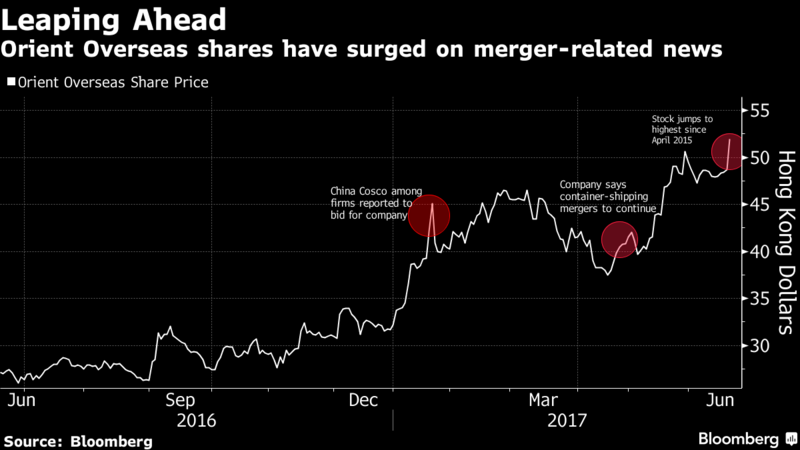
Cosco Shipping Holdings plans to buy Orient Overseas Container Line (OOCL) with the help of Shanghai International Port Group (SIPG) for $6.3 billion, in a deal that would maintain the Hong Kong carrier’s brand and marks a new chapter in ongoing industry consolidation.

The deal, subject to regulatory approvals, culminates long-running speculation that Cosco would purchase OOCL, a carrier seen by some analysts as the only attractive takeover target of substantial size remaining in the market following rapid carrier consolidation over the past year and a half.


The combined Cosco Shipping, a subsidiary of Cosco Shipping Holdings, and OOIL would have a fleet of more than 400 ships and a total capacity of 2.9 million TEU including the orderbook. Together, Cosco and OOCL would operate the third-largest mega-ship fleet and be the second-largest mover of US containerized goods would be created, according to an analysis of PIERS data and the IHS Markit orderbook.

Under the deal, OOIL would keep its Hong Kong corporate headquarters and the independent share listing. It would also put off any headcount reductions at OOIL for at least 24 months, Cosco said in a statement. Cosco acknowledged the separate and distinct culture that has led OOCL to become of the industy’s best performing and highest regarded carrier in the eyes of BCOs, and clearly indicated that was an important part of the value it was acquiring.

“We respect OOIL’s management team and its expertise, not to mention its people, brand and culture,” said Wan Min, chairman of Coscol Shipping Holdings.


By leveraging the strengths of each company and achieving synergies, the businesses aim to enhance their operating efficiencies and competitive positions to achieve sustainable growth in the long term. Both companies are members of the Ocean Alliance, and will continue to work together under this framework.

“We are proud of the business we have built and the people who have been building it. This decision has been carefully considered and we believe it helps ensure the future success of OOIL. We are confident that Cosco Shipping Holdings is the right partner for us,” OOCL CEO Andy Tung said Sunday.

It came as little surprise that Cosco would maintain OOCL as a standalone brand. OOCL is known for a high quality of service relative to many of its competitors, as well as strong BCO relationships, and CMA CGM and Maersk Line have maintained the APL and Hamburg Sud brands, respectively, after their acquisitions. Given legacy cultural differences — Cosco being a Beijing state-owned enterprise and OOCL a fully commercial, standalone business — a full integration would be seen as extremely difficult. Even prior to the acquisition, Cosco and OOCL were drawing increasingly closer particularly in their participation in the Ocean Alliance.

The deal continues what has been a breakneck pace of consolidation in container shipping and raises further questions about the surviving carriers’ ability to parlay that concentration into pricing power. Rates overall have been on the upswing this year, but that can be easily attributed to capacity dislocations as the new alliances phased into service in April, as well as accelerating trade growth driven in part by Europe's economic recovery, the sustained US recovery, and economic growth in many developing markets, bolstering the slowing but largely uninterrupted growth in China.

Given carriers’ history of predatory rate wars with the ultimate — in some cases overtly stated — purpose of knocking competitors out of a market or out of business entirely, a cultural shift by carriers into an oligopoly environment will not occur overnight or easily, especially under the harsh gaze of antitrust regulators, principally in the United States and Europe.

In maritime analyst Drewry’s analysis of rates across the first half of the year, it found that its Global Freight Rate Index across a wide spectrum of trades was 36 percent higher after six months of 2017 versus the same period in 2016. However, Drewry did note that last year was exceptionally poor for carriers trying to secure compensatory rates, and when compared with the first half of 2015, spot rates for the first six months of 2017 were still 4 percent lower.

Nevertheless, rate increases on the spot market have been more muted in the eastbound trans-Pacific, where spot rates are up 33 percent from last summer, compared to the Asia-Europe trade lane, where the increase is 61 percent. Other, smaller trade lanes such as Asia to Brazil have seen huge increases in recent months.

There is little evidence thus far that industry concentration by itself is has translated into any kind of unspoken truce by carriers in pricing. But that said, carriers’ vessel ordering has slowed significantly and industry analysts are predicting that by 2019 the market could turn decisively in carriers’ favor, again not due to concentration by itself, but rather a slowdown in capacity additions combined with stronger trade growth driven by healthier economies in Europe and North America, and a steadily growing middle class in China.

Cosco, for example, earlier this month told its investors they can expect a $272 million profit for the first half, turning around a $1 billion loss recorded in the first six months of last year as the carrier benefits from rising container volume and freight rates. Cosco said its average freight rates in the container shipping business increased in the first half year over year, with cargo volume growing by 34.72 percent, driving up profitability.

OOCL reported a $273 million loss in 2016 as weak freight rates dragged down the average revenue per TEU by almost 19 percent to just $774 per container. Although it did not disclose earnings for the first quarter, Cosco on April 28 reported volume rose 7 percent year over year, while revenue increased 6.4 percent, to $1.18 billion. Overall revenue per TEU, however, slipped 0.6 percent from first-quarter 2016.

Wednesday

NYK LINE, MOL, K-Line MERGER TO FORM OCEAN NETWORK EXPRESS REJECTED

The South African Competition Commission has rejected the merger of the container divisions of NYK, MOL and K Line to create Ocean Network Express.

In South Africa, NYK operates its shipping business through the Mitchell Cotts Maritime agency; MOL through subsidiaries MOL South Africa and MOL ACE South Africa; and K Line though K Line Shipping South Africa.

The SA commission judged that on the evidence of past collusion between container shipping firms, the merger would have led to an increased likelihood of further anti-competitive behaviour.

“The commission has found that the structure of the container liner shipping market is conducive to coordination, based on previous collusive conduct in the container liner market in other parts of the world.

“The merger increases the likelihood of coordination as it creates further structural linkages in the container liner market,” it said.

While the creation of Ocean Network Express was solely limited to the shipping companies’ container businesses, the commission also looked at whether it would affect the car-carrying business, especially after the car-carrying divisions of all three were found to be part of price-fixing cartel,  which also included Hoegh, Walenius Wilhelmsen, EUKOR and CSAV, in the inbound US trade.

“The commission also found that the proposed transaction creates a platform for coordination in the car carrier market which has a history of collusion involving the merging parties. The parties have been prosecuted in some jurisdictions, while investigations are underway in others. It is the commission’s view that the merging parties may require a formal mechanism for the further collusive conduct in the car carriers market. The joint venture provides such a mechanism.


“The commission is of the view that the proposed transaction is likely to increase the scope for coordination in the container liner shipping market, while creating a platform for coordination in the car carrier market.

“The commission further found that there are no efficiencies that outweigh the anticompetitive effects of this transaction and that there are also no remedies sufficient to address these effects,” it said.

The proposed Ocean Network Express also continues to await a decision from the US. Last month, the Federal Maritime Commission (FMC), to which the lines had submitted their merger proposals, decided it could not rule on mergers, as they are de facto acquisitions.

FMC chairman Michael Khouri said: “The Shipping Act expressly excludes acquisition agreements from the act’s coverage. The cases that address the commission’s authority to review these types of agreements have noted that Congress gave the commission the power to review cooperative agreements that produce efficiencies, in order to prevent consolidation.

“This proposed agreement is not the type of arrangement in which the parties would surrender control over a particular matter for the duration of the agreement but maintain their separate identity and original independence in the same line of business in all other respects. Thus, the commission has determined that the creation of the joint venture, including the pre-consolidation cooperation intended to facilitate and permit its creation, falls outside the commission’s jurisdiction.”

MAERSK IN CYBER ATTACK

“We can confirm that Maersk IT systems are down across multiple sites and business units due to a cyber attack,” it said on its website. “We continue to assess the situation. The safety of our employees, our operations and customer’s business is our top priority. We will update when we have more information.”

Ukraine’s government, its National Bank and large power companies have also been affected, as has Russian oil company Rosneft, and Kiev Airport.

The airport noted: “Our IT services are working together to resolve the situation. There may be delays in flights due to the situation… The official site of the airport and the flight schedules are not working.”

According to media reports, companies are receiving a ransomware note in English, demanding $300 in Bitcoin, similar to the recent WannaCry ransom.

Maersk Line UK informed customers via Twitter in the morning that: “Unfortunately our computer systems here in the U.K. & Ireland are down. Our phone systems are live and we’re on hand to answer any Q’s.” It only admitted to a cyber attack several hours later. Subsidiary Damco’s website appeared to be working normally, however.

Tuesday

MV THERESA ARCTIC SALVAGE UNDERWAY IN KENYAN COAST : KILIFI

Product tanker THERESA ARCTIC ran aground on reefs in the afternoon June 20, in position 03 39S 039 53E, off Kilifi port, Kenya, north of Mombasa Port of Kenya. Vessel loaded with 27500 tons of vegetable oil was en route from Port Klang Malaysia to Mombasa, says Andrew Mwangura, Mombasa.

As of June 26, vessel was still aground, Smith Salvage and local company Alpha Logistics contracted for salvage, four tugs were already deployed, but reportedly, lightering is required. No information on hull breaches and leak, understood no leak yet. Crew remained on board.

Understood on a photo from The Star Kenya grounded THERESA ARCTIC.


Product tanker THERESA ARCTIC, IMO 8715508, dwt 84040, built 1988, flag Tuvalu, manager (according to AIS) RAFFLES SHIPMANAGEMENT SERVICES PRIVATE LTD, Singapore.