الخطوط الملاحية الأفريقية ASLINE - AFRICAN SHIPPING LINE - The World's Gateway to Africa...بوابة العالم إلى الموانئ الأفريقية ...Dünyanın Afrika Limanlarına Açılan Kapısı...世界通往非洲港口的门户......WEEKLY VOYAGES CONNECTING CHINA, MALAYSIA, THAILAND, INDIA, SRILANKA, PAKISTAN, DUBAI TO THE FOLLOWING AFRICAN PORTS : #MOMBASA #DARESALAAM #MOGADISHU #KISMAYO #BOSASO #BERBERA #DJIBOUTI #PORTSUDAN #NACALA #DURBAN #LUANDA #LOBITO #DOUALA #APAPA #TINCAN #LOME #TEMA #ABIDJAN #BISSAU #DAKAR

ASLINE - AFRICAN SHIPPING LINE DUBAI

Thursday

CHINA GIVES $6.3 BILLION IN A LAST MINUTE OOCL BUY OUT

China’s anti-monopoly bureau has given the green light to COSCO’s $6.3bn takeover of OOIL, including its container arm, OOCL. The stock exchange eleventh-hour notification made no reference to the outstanding approval still required by US foreign investment regulators.

A joint statement from COSCO and OOIL advised that, on 29 June, the Anti-Monopoly Bureau of the State Administration for Market Regulation of the PRC had decided “not to prohibit the offer”.


Chinese regulatory approval came just one day before the deadline to fulfil all of the pre-conditions of the deal, set when the takeover was announced on 7 July 2017.  The parties to the deal, which includes a 9.9% minority share for state-owned Shanghai International Port Group (SIPG), said that following the final condition having been met, the ‘composite document’ would be despatched “within seven days” from 29 June after which a further announcement would be made.

Alphaliner noted that under the terms of the deal, COSCO has until Friday to submit the final ‘composite document’ to complete the acquisition.

It added: “The two companies’ announcement failed to mention the status of the review by the Committee on Foreign Investment in the United States (CFIUS) that is focused on ownership of OOCL’s Long Beach Container Terminal.”


The consultant explained: “The US terminal would come under COSCO control and CFIUS approval is still pending due to national security concerns.” In the past year, CFIUS has vetoed a number of deals involving Chinese buyers on the basis of a “threat to national security”.

Indeed, against the backdrop of an escalating trade spat between the US and China, the Trump administration made it known yesterday it intended to block China Mobile’s application to provide telecoms services in the US, again citing national security concerns.
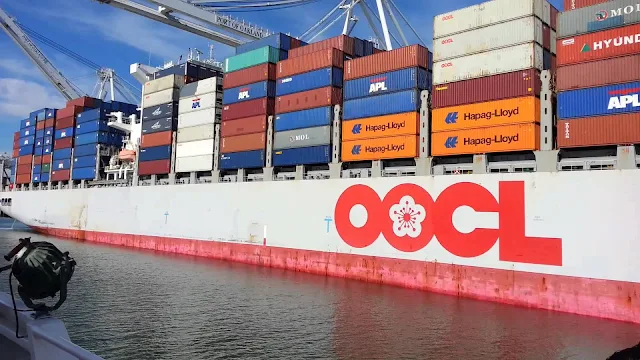

In April, COSCO’s vice-chairman, Huang Xiaowen, said the company was “still answering questions” from CFIUS relating to OOCL assets in the US. The sticking point seemed to be OOCL’s Pier E / Pier F Long Beach Container Terminal which would add to COSCO’s controlling interests at two other facilities at the San Pedro Bay port complex.

Since Mr Xiaowen’s response to investors there has been no official update on the carrier’s negotiations with CFIUS.

Separately, Alphaliner said shares in COSCO Shipping Holdings had plunged by 25% since June amid mounting China-US trade tension, and were further hit last week by ripples from Hapag-Lloyd’s profit warning, which spooked liner shipping investors.

Assuming the COSCO/OOCL deal completes, it will propel the combined entity to third place in the ocean carrier rankings, with a fleet capacity of 2.74m teu, ahead of CMA CGM’s 2.62m teu.

COSCO says it intends to maintain the OOCL brand after the acquisition, but there have been no details and, according to one of The Loadstar’s sources, OOCL staff have not been informed whether their jobs are secure in the new set up.


Wednesday

LIVESTOCK EXPORTS INCREASE FOR HAJJ : SAUDI ARABIA

Saudi Arabia has lifted the ban on Somali livestock imports, official confirmed.

Livestock, Range and Forestry minister Sheikh Nur Mohamed Hassan said the decision followed discussions with the Saudi authorities. Saudi Arabia banned the Somali livestock imports in September 2016 following reports of an outbreak of Rift Valley Fever in the Horn of Africa country.


“Saudi officials realized that the Somali livestock were healthy,” said Mr Hassan adding “The health and quality concerns raised by the Saudis have now been cleared,”


The minister confirmed that export would soon resume.

“Up to 1.1 million goats will be exported to Saudi Arabia prior to this year’s Hajj (the pilgrimage to Mecca about two months from now),” stated Mr Hassan.

Somalia also exports livestock to Egypt, Oman and Yemen. However, Saudi Arabia remains the largest Importer of camels, cattle, goats and sheep from Somalia.

Somalia has previously exported 5,000 herd of cattle to the United Arab Emirates courtesy of the AFRICAN SHIPPING LINE -SOMALIA through Mogadishu and Berbera Ports. The company is a regular exporter of livestock from Somalia to the Gulf countries.

Other Countries that have Livestock Exports include Kenya, Djibouti. Livestock Import countries include Mauritius, Seychelles Turkey.

We can get some livestock for you from Africa especially Kenya, Somalia, Djibouti or Tanzania. Please send an email: africanshippingdubai@gmail.com or call/whatsapp +971 56 953 8569 or +254 726 722 226
  اغنام صـومـالـي  بيع جميع انواع المواشي والأغنام 🐐🐄🐏 جملة & مفرد تصدير إلى جميع دول الخليج العربي للاستفسار اتصل بنا على +971 56 953 8569


Tuesday

CHINA- BELARUS-GERMANY CONTAINER SHIPPING

A delegation of Belarusian Railways led by the company chief Vladimir Morozov will take part in talks with top officials of the Port of Duisburg (Germany) on 19 June, BelTA learned from the press service of Belarusian Railways. “The parties will discuss the proposals of the German company to start freight container shipping along the China-Belarus-Germany (Port of Duisburg) route, as well as promising areas of cooperation with Belarusian Railways taking into account the plans to expand the China-Belarus Industrial Park Great Stone,” the press service informed.

The Belarusian delegation will tour the terminal railway infrastructure of the port and study its technical and technologies capacities to handle container trains. “The relevance of this proposal can also be attributed to the capacities of the Great Stone park. Belarusian Railways is ready to cooperate with the business community of the European Union on mutually beneficial terms,” the press service noted. Belarusian Railways is actively developing container shipping not only through the border checkpoints Brest-Terespol, but also through other Belarusian-Polish border checkpoints: Bruzgi-Kuznica Bialostocka and Svisloch-Siemianowka that handle cargo on the East-West-East route on the 1520mm and 1435mm gauge tracks. Belarusian Railways plans to resume cargo delivery through the border checkpoint Vysoko-Litovsk – Czeremcha by the end of 2018.

The Belarusian rail operator pays particular attention to the transshipment of containers on the Belarusian side. The projected growth of container traffic on the East-West-East route is 540,000 containers in TEU per year by 2020 and 1 million containers in TEU per year by 2025. In January-May 2017 some 104,200 containers in TEU moved along the China-Europe-China route, up by 21.9% as compared to the same period a year before. Plans are in place to transport 415,000 containers in TEU along the China-Europe-China route via Belarus in 2018.
Source: BelTA

Wednesday

CONTAINER LINE CMA PIONEER DIES

Jacques Saadé, who built French shipping company CMA CGM into the world’s third-largest container operator, has died at the age of 81, the company said.

CMA CGM didn’t disclose the cause of death. It comes a year after Mr. Saadé passed the reins of the Marseille-based company to his son Rodolphe, who is chairman and chief executive officer. The company operates around 500 container ships, sailing to 420 ports world-wide.


Mr. Saadé was one of the first industry executives who believed containers would dominate global trade. He launched CMA CGM’s first office in Shanghai in 1992, saying that China would become the “world’s factory.”

These days, container ships move 98% of the world’s manufactured products ranging from designer dresses and home appliances to furniture, heavy machinery and food.

“Jacques Saadé dedicated his life to CMA CGM,” the company said in a statement. “An extraordinary visionary and entrepreneur, he made the group into a world leader in the maritime transport of containers, developing the company in more than 160 countries, while maintaining the family dimension with its values.”

Born in Beirut in 1937, Mr. Saadé fled Lebanon in 1978 to protect his family from civil war and moved to Marseille, where he set up Compagnie Maritime d’Affretement (CMA), with a single ship sailing from France to Lebanon.

He sent his first ships across the Suez Canal in 1983 and CMA was among the first liners to launch a service linking North Europe with Asia in 1986.

Mr. Saadé was an early believer in consolidation. In 1996, he acquired France’s Compagnie Générale Maritime (CGM) to form CMA CGM, which over the years swallowed up a number of rivals, including Singapore’s Neptune Orient Lines for $3.4 billion in 2016.

CMA CGM was badly hurt by the 2009 economic crisis, but stayed afloat after Turkish family-run Yildirim Holding AS invested $600 million for a 24% stake.

The cash injection strengthened CMA CGM’s finances and secured funding to build a series of giant container ships that sail between Asia and Europe and across the Pacific. The ships are part of the Ocean Alliance, which also consists of Chinese behemoth Cosco Shipping Holdings Co., Taiwan’s Evergreen Marine Corp. and Hong Kong’s Orient Overseas International Ltd.

In 2011, he built CMA CGM’s new headquarters in Marseille, a 147-meter (482-foot) glass tower designed by renowned architect Zaha Hadid. It is the city’s tallest building and CMA CGM is also Marseille’s largest employer with around 2,500 workers.

Mr. Saadé graduated with a business degree from the London School of Economics in 1957. On the advice of his father, who ran tobacco, cotton seed and olive oil businesses in Syria, he became an intern in New York to learn about shipping.

He understood the potential of the container used by the U.S. army during the Vietnam War, telling the French business newspaper Les Échos it was “an excellent idea for transporting goods as it was closed, easy and quick.”

“With the death of Jacques Saadé, Marseille has lost one of its most important ambassadors,” city mayor Jean-Claude Gaudin said in a statement.

Saturday

CONTAINER SHIPPING LINES PUSH FOR RATES INCREASE AS CAPACITY BEGINS TO TIGHTEN

Asia-North Europe ocean carriers are looking to hike container shipping rates by up to $500 per teu from 1 July, as space availability begins to tighten with the start of the peak season.

Carriers appear to be adopting a “shock and awe” tactic of a substantial FAK increase rather than gradual smaller rises, knowing they may not get a better opportunity before demand weakens again as the peak season fizzles out.


One carrier source told The Loadstar's Mike Wackett this week it had decided to “make a statement” with a significant increase.

“We know we will not get the full amount, but even if we had asked for $200 we wouldn’t get that either, so we have nothing to lose and more to gain,” he argued. The FAK announcements come as container spot rates continued to soften across all major trades this week.

The Shanghai Containerized Freight Index (SCFI) fell 3.4% this week to 751, more than 9% down on a year ago. The North Europe component declined 3.2% on the week, to $834 per teu, as carriers postponed emergency bunker surcharges (EBS) amid fears of conceding market share to rivals. On the more robust Mediterranean trade, spot rates edged down by a smaller 1.1%, to $905 per teu.

But transpacific carriers suffered another disappointing week with spot rates losing more ground.

Rates from Asia to the US west coast tumbled 5.7% to $1,194 per feu, and for east coast ports there was a decline of 2.5% on the week, to $2,181 per feu. After a 6.8% fall the previous week, rates to the US west coast are now at levels that are hurting carriers serving the route. The container lines had been obliged to cancel planned 15 June GRIs due to a dip in vessel utilisation levels, and this week saw the first reaction from the carriers: MSC announced it was to terminate its New Eagle service, jointly operated with 2M partner Maersk Line (TP1) early next month.

The weekly loop, with a rotation of Kaohsiung-Yantian-Xiamen-Shanghai-Busan-Vancouver-Seattle and then back to Asia, deploys six panamax vessels, four operated by MSC and two by Maersk.

MSC said it was “as a result of the challenging operating environment for business on the transpacific trade”.

It offered a “contingency plan” for the transfer of forward bookings onto other loops, which it said, it hoped would give “limited disruption” to shippers.

And, in addition to the current demand-supply imbalance, transpacific carriers face further problems from the fallout of the escalating trade war between the US and China. Alphaliner estimated this week that the punitive tariffs being imposed by both nations could wipe out around 7% of transpacific volumes from next month.

AFRICAN SHIPPING LINE OPERATIONS

Tuesday

SHIP AGENCY - CONTAINER - PORT OPERATION- TRANSIT LOGISTICS


SHIPPING CONTAINERS, BREAK BULK FROM THE FOLLOWING PORTS: 

1. Dubai (UAE)

2. Jeedah (KSA)
3. Mogadishu (SOMALIA)
4. Djibouti 
5. China Ports
6. Karachi (PAKISTAN)
7. Mumbai (INDIA)

And other African Ports in West Africa. For Transportation of the Containers from Either Mombasa or Dar Es Salaam to Inland African Cities and Towns including : Nairobi, Kampala (Uganda), Kigali (Rwanda), Bunia, Kolwezi, Butembo(RDC Congo), Beni, Kisangani(RDC Congo), Bukavu, Likasi, Lubumbashi (RDC Congo), Bujumbura (Burundi), Mzuzu, Goma... Blantyre, Lilongwe (Malawi) , 


Please send a direct email to either: 
Ship Agency/Container Enquiriesafricanshippingdubai@gmail.com 

For Somalia Air Shipment/ Container Transportation: asline.somalia@gmail.com
Ethiopia Container Transport : africanshippingdubai@gmail.com


Friday

USED CONTAINERS FOR SALE : MOMBASA, NAIROBI IN KENYA AND KAMPALA, UGANDA

AFRICAN SHIPPING LINE - Port Logistics once again have Shipping Containers ready for quick sale, which are in Good Sea Worthy condition, in Nairobi, Mombasa in Kenya and Kampala Uganda

OVER 200 CONTAINER UNITS AVAILABLE in any one Shipment. All Rates are Negotiable and Clients are advised to Get a Receipt along with Certificates and CW Plates

Please Speak/Whatsapp Mr. Ibraheem on +254726722226/ + 97156 953 8569 Email: asline@africanshippingline.ae  or africanshippingdubai@gmail.com Website: www.africanshippingline.com 

N/B: Good discount given for bulk buyers and commissions given for referrals;

Total Price in Mombasa, Kenya : 

20ft = $1600       
40ft =$2600


Used Containers 20ft and 40ft in Kenya, Mombasa and Nairobi and Kampala, Uganda

Total Prices in Nairobi 

20ft = $1800
40ft = $2800 (Without Transport)

Inside the Used Containers for Sale in Kenya
Total Prices in Kampala 

20ft = $2000
40ft = $3200 (Without Transport)


Reefer Containers for Sale in Mombasa, Nairobi, Kenya
Reefers

Total Price in Mombasa

20ft = $7200
40ft = $9200 (Without Transport)

N/B: Good discount given for bulk buyers and commissions given for referrals;

Used Containers for Sale in Uganda, Kampala

Viewing and reserving a container/s with us is important. Our Depot Managers recommend earlier appointments for viewing and actual sale.

Used Container Trading Kenya Uganda
Terms of payment 
Bank to Bank Transfers with RTGS copy as proof of payment, and you get release order on confirmation of payment, Cheques accepted, but release Order issued upon funds receipt confirmation.

NB; 
All units, are Ex EU, legally owned, some with valid CSC plates and can be used for export, and sold with Inter-change, and all relevant documents, including, Invoice, receipt, and Condition Report, and we will undertake minor repairs, paint and Cleaning if required, and have sold over 2500 without a problem.

We also offer, leasing, storage units, and transport at very discounted rate, and Container modification, to accommodation units, shops,

Toilets & washrooms, living quarters, according to customer demand (Transport empty containers @ Ksh 50K -Mombasa – Nairobi per truckload)

Email: asline@africanshippingline.ae or africanshippingdubai@gmail.com 

Wednesday

THE LAUNCH OF AFRICAN SHIP OWNERS ASSOCIATION IN SYCHELLES

The President of the Republic of Seychelles, Mr Danny Faure, officially launched the first African Shipowners Association Summit 2018 during an official opening ceremony held at the Savoy Resort this morning.

The 2018 African Shipowners Association Summit is being held from 23 to 25 April 2018, and is hosted for the first time in Seychelles by the Seychelles Petroleum Company Limited (SEYPEC) in collaboration with the African Association of Shipowners, Department of Foreign Affairs and the African Union Commission under the guided theme “Promoting African Ownership and Participation in African’s Shipping and Maritime Sectors.”


During his address to officially declare the summit open, President Faure highlighted the importance of such an event and for the African continent to seize the rich opportunities that the maritime sector offers, particularly in terms of sea trade. He also said that the event is an occasion to focus on the promotion of African ownership and participation in shipping and maritime sectors.

“The African continent is the second biggest continent in the world, with a total coastline of over 26,000 nautical miles, including its islands. 38 out of 54 countries on the continent are either coastal or island states. International trade is a vital economic activity to many African countries, of which over 90% is conducted by sea.  Yet, it is estimated that African owned ships account for only about 1.2% of the world shipping by number and 0.9% by gross tonnage. This illustrates significant room for improvement and growth on the current overall outlook in this important sector for our economies,” said President Faure.

President Faure also emphasised that the summit provides an ideal platform for interaction, information sharing, and exploration of ideas on how the African shipping and maritime sectors can be developed further to achieve a higher yield for the continent.

“As the Host of this Summit, Seychelles, despite being a small island state, has much to share with our African counterparts. The geographical setup of our islands is made up of only 450 square kilometres of land but an Economic Exclusive Zone of 1.5 million square kilometres.  This has compelled us to venture towards the sea in developing Seychelles into the High-Income Country that it is today. During this two day summit, it is expected that we learn from each other and leave with additional knowledge, insight, and inspiration on how we can capitalise on the opportunities that exist within the maritime industry in Africa and beyond, for the benefits of the African continent and its people,” said President Faure

During the ceremony the President also announced the allocation of land in Seychelles for the construction of a Pan African Shipping Line Head Office as a centre for all shipowners in Africa, which will act as a hub for all activities related to the shipping and maritime sectors.


The two day summit includes the participation of representatives of African Shipowners Association, African Union, Shipowners, representative of Ports, Government officials and other relevant African maritime authorities who will take part in the working sessions and discussions.

Also present for the ceremony this morning was the Vice President of Seychelles, Mr Vincent Meriton, the Secretary of State for Foreign Affairs, Ambassador Barry Faure, the Minister for Tourism, Civil Aviation, Ports and Marine, Ambassador Maurice Loustau-Lalanne, Ministers, AU Commissioners, the Secretary General of the African Shipowners Association (ASA), Ms Funmi Folorunso, the Chief Executive Officer of the Seychelles Petroleum Company (SEYPEC), Mr Conrad Benoiton, Principal Secretaries, Summit delegates and other distinguished guests

Thursday

MOMBASA PORT NOW SEES BRIGHT FUTURE AS LARGEST CONTAINER SHIP SAILS

One of the world's largest cargo ships sailed into Mombasa on Monday, signalling that the port's expansion was paying off. Residents lined the Likoni ferry crossing to watch the massive MV MSC Portugal sail up the channel into Kilindini Harbour.


According to Kenya Ports Authority (KPA), the safe navigation into the channel by the ship carrying 6,000 twenty-foot containers indicated the port had finally become a world-class facility.

The vessel, with a length equivalent to three football fields, is the longest container ship to call at the port. It was piloted into the harbour by the port's Operations General Manager William Ruto. The 74,962-tonne ship sails at 24.6 metres depth, displacing 14.518 metres of water in its wake.

It carries 3,105 twenty-foot containers in its cargo space and another 3,550 on the deck. "This vessel is not just an ordinary container ship owing to its size, she can only call at big ports like Reunion and Mauritius in the region, not smaller ones,” said Captain Ruto. He spoke shortly after disembarking from the vessel he navigated in a record one-and-a-half hours from the entrance of the channel. Visiting ships sailing up the Kilindini channel are usually navigated by local pilots to ensure maximum safety of the vessels and their cargo.

Flying the Liberian flag, the ship was expected to offload 1,000 containers and load a similar quantity. Until the completion of a dredging project to minus-15 metres, the channel was restricted to vessels with a maximum depth of 11 metres. The port is now capable of handling third and fourth generation vessels with capacities ranging between 4,500 and 6,000 twenty-foot containers. Other large ships that have called at the port in the recent past include MV Ever Delight and Ital Mattina, with an overall length of 264 metres. Others are MV MSC Tia - of 261 metres - and MV Jolly Quarzo, with a length of 240 metres. The vessels' maiden calls marked a major achievement in the Government’s port expansion programme. Meanwhile, nine container ships docked at the container terminals recording a ship average working time of 3.31 days in the week that ended on April 25.

The vessels discharged a total of 10,391 twenty-foot containers and loaded another 10,246 twenty-foot containers as import container dwell time registered 4.98 days. Import containers declined by 4,647 while exports recorded a decline of 985. The delivery of containers through the Standard Gauge Railway (SGR) recorded 2,898 twenty-foot containers while road transport evacuated 8,579. During the week under review, the total container yard population recorded 19,013 twenty-foot containers. These comprised 7,037 twenty-foot containers awaiting pick-up order, 3,281 ready for collection, 1,750 full exports and 2,023 trans-shipments. Others included 3,962 Twenty Foot Equivalent Units (TEUs) empties and 960 TEUs at the customs warehouse. Local imports registered 4,074 twenty-foot containers while transit-bound containers recorded 3,991. Uganda-bound cargo recorded 3,033 TEUs to retain her leading position in the transit market segment. Other transit countries are Tanzania that registered 379 TEUs, South Sudan with 213 TEUs, Democratic Republic of Congo with 169 TEUs, Rwanda with 146 TEUs, and Somalia and Burundi, which recorded 29 TEUs and 12 TEUs respectively.


The weekly performance at the conventional cargo terminal revealed that 14 general cargo ships docked and discharged 167,721 metric tonnes. A total of 26,849 metric tonnes were loaded for export. Cargo delivered by road transport recorded 104,387 metric tonnes while the conveyor belt evacuated 63,334 metric tonnes. Wheat emerged the leading import commodity registering 63,334 metric tonnes, followed by 62,400 metric tonnes of clinker and 21,000 metric tonnes of illuminate exports.

Other commodities handled in large quantities included 18,812 metric tonnes of fertiliser and 4,894 metric tonnes of sorghum. Motorcar carriers discharged 256 units of cars and 70 trucks. A forecast for the next two weeks indicates that 21 general cargo vessels are expected to discharge 327,562 metric tonnes and load another 2,492 metric tonnes. The container terminals are expected to received 13 ships to discharge 7,247 TEUs and load 7,095 TEUs.

PIL KENYA STARTS TO USE SGR


The Kenya Railways (KR) on Friday got a boost after another shipping line committed to transport cargo from Mombasa Port to the Inland Container Deport (ICD) in Nairobi through the standard gauge railway (SGR).

PIL (Kenya) Ltd on Friday flagged off a full block of freight trains to Nairobi after signing an agreement with KR at the port.

The signing of the agreement and the commencement of transportation of cargo by the shipping line is expected to boost SGR freight services.The train loaded with 180 containers left Mombasa Port at 4pm for ICD in Nairobi.

TEMA PORT : WEST AFRICA GAINING MOMENTUM

Anthony Firmin, chief operating officer at Hapag-Lloyd, said:  "Our West Africa Express (WAX) service from and to West Africa has been operating with extraordinary success for several years and is very well received by customers.

"With our new East Africa Service (EAS), connecting Saudi Arabia with Kenya and Tanzania, we have entered another new trade. As a result, we are tying Africa even more closely to our global network while benefitting at the same time from positive economic developments in large parts of Africa," he added.


Hapag- Lloyd said the GDP of West Africa has grown significantly in the last two years, rising by an average of 6 percent annually, with Ghana among the fastest growing economies in the region. Growth has been driven primarily by the trade in gold but also in oil and gas products.

Ghana is gradually becoming a trans-shipment hub in West Africa following expansion works carried out at the Tema Port, Mr Anthony Firmin, the Chief Operating Officer of Hapag Llyod, a German shipping Line, has said.

“The growth of Tema Port will further reinforce the role of Ghana as a hub for West Africa.”

At a Press Conference to announce the official opening of its new offices located in Tema, Mr Firmin recounted that Ghana’s economy was strongly growing. He noted that his company chose Ghana because the country was not only politically and legally stable, but was business friendly, making many multinationals in West Africa to set up their regional offices here.

Mr Firmin said Ghana’s strong regional setting also offered a springboard into Africa and access to market of 350 million inhabitants.He said his organisation for the past three years had offered expertise and support in the exportation and importation of perishable items such as yam, fruits and fish to Europe and across the globe. Mr Firmin was also pleased that the company’s enhanced presence in West Africa was showing signs of success.

“Our West African Express (WAX) service to and from West Africa has been operating with extraordinary success for several years and is very well received by customers.

“With our new East Africa Service (EAS), connecting all major trades globally via our hub in Saudi Arabia with Kenya and Tanzania, we have entered another new trade.

“As a result, we are tying Africa even more closely to our global network while benefiting at the same time from positive economic development in large parts of Africa,” he said.

He said Ghana was among the fastest growing economies in the Region, adding that her growth was primarily driven by the trade in gold, oil and gas products. Mr Firmin said Ghana’s ports handling capacity was likely to triple by mid-2019, from one million to three million Twenty Equivalent Unit (TEU).

“Hapag-Llyod is expecting additional growth opportunities from this capacity expansion,” he added.

Hapag Llyod is one of the world’s leading shipping lines with a fleet of 219 modern container ships and total transport capacity of 1.6 million TEU. It has about 12,500 employees with over 380 offices in 125 countries.

Wednesday

COSCO TAKE OVER OF OOCL COMPLETE BY END- JUNE: VICE CHAIRMAN

SHANGHAI (Reuters) - COSCO Shipping’s (601919.SS) planned acquisition of Orient Overseas Container Line (OOCL) is on track to be completed by the end of June, the company’s vice chairman Huang Xiaowen said on Tuesday.

COSCO is still answering questions from the Committee on Foreign Investment in the United States on the deal, and is also awaiting a number of domestic approvals, Huang told a press conference in Shanghai.

He said the deal needed U.S. approval as OOCL had some assets in that country. “Up to now we are quite confident to push forward this acquisition ... it’s progressing normally,” he said.

COSCO last year offered to buy Orient Overseas International Ltd (OOIL) (0316.HK) in a $6.3 billion deal that will see the Chinese shipping giant become the world’s third-largest container shipping line. OOCL is the main subsidiary of OOIL. The company said in July last year that the transaction would be completed by June 30 and the deal had already received approvals from European and United States anti-monopoly regulators.

The proposed deal is the latest in a wave of mergers and acquisitions in global container shipping that has left the top six shipping lines controlling 63 percent of the market and comes at a time when the industry is experiencing recovery after a lengthy downturn.

COSCO said last week it expected further growth in container shipping demand thanks to a continued recovery in global trade, after reporting that it had swung to a net profit of 2.7 billion yuan ($429.42 million) for 2017. Huang said the company was also keeping a close eye on rising trade tensions between China and the United States, trade between which currently contributes to about 15 percent of its cargo volumes.

Wang Haimin, COSCO’s general manager, said there was currently little evidence that the tensions were affecting cargo volumes but noted that the company had reduced its U.S. capacity slightly over the past few years as part of its restructuring.

“We will take appropriate action to protect our company’s market as well as the rights and interests of our customers,” Huang said.

Thursday

DJIBOUTI PLANS NEW CONTAINER TERMINAL TO BOLSTER TRANSPORT HUB ASPIRATIONS

Djibouti is in talks with French shipping company CMA CGM to develop a new container terminal at an initial cost of $660 million as part of the tiny African country’s bid to expand into a sea and air transport hub for the continent.

Aboubakar Omar Hadi, chairman of the Djibouti Ports and Free Zone Authority (DPFZA), told Reuters on Tuesday that the authority hopes to award the concession in July. It was also prepared to buy out DP World’s stake in an existing container terminal to end a row with the Dubai port operator and avoid arbitration, he said.

Djibouti’s strategic location has led the United States, China, Japan and former colonial power France to build military bases there.Its ports already serve as an entry point for cargo which is then sent by smaller vessels to ports along Africa’s eastern coast, but it is now seeking to become a sea-air trans-shipment hub for the entire continent.

To do this, Hadi said DPFZA was also planning to construct a $350 million airport and expand Air Djibouti’s fleet of cargo aircraft. The new container terminal project could break ground as early as September with construction expected to take 24 months, Hadi said, speaking on the sidelines of the Africa CEO Forum in Abidjan, Ivory Coast.

“We are going to build DICT, Doraleh International Container Terminal. This is a new plan,” he said. “We are in discussions with CMA CGM.”


The port authority was not in talks with any other potential partners, he said. Shipping group CMA CGM declined to comment. Once operational, Hadi said the port terminal would boast an annual capacity of 2.4 million twenty-foot equivalent units (TEU), but subsequent expansion phases would bring that up to 4 million TEUs. Fifteen percent of the project’s cost will be financed through equity. Of that, the DPFZA will contribute 85 percent, with its concession partner providing 15 percent. The rest will be raised via international institutions and banks.

“We are targeting trans-shipment,” Hadi said.

Meanwhile, Hadi said the port authority was ready to end a dispute with DP World over its cancellation of a concession contract for another facility, the Doraleh Container Terminal, by buying out DP World’s 33 percent stake. Djibouti ended the contract with the Dubai state-owned port operator last month, citing a failure to resolve a dispute that began in 2012.

DP World has called the move illegal and said it had begun proceedings before the London Court of International Arbitration, which last year cleared the company of all charges of misconduct over the concession.

“We are prepared to pay them their 33 percent of shares,” Hadi said. “There is no need for arbitration. We are going to buy their shares.”

Tuesday

STRIPPING OF ZANZIBAR CONTAINERS AT MOMBASA PORT STOPPED

Stripping involves offloading various small consignments from a single container /FILE.
Mombasa, Kenya – The Kenya Revenue Authority (KRA) has banned the stripping of cargo containers at the port of Mombasa before onward conveyance by dhows to various consignees in Zanzibar.

The move is meant to curb sea smuggling where cargo is diverted in the ocean, finding its way into the local EAC market. Stripping involves offloading various small consignments from a single container.

As a result of cargo diversion, the volumes of cooking oil destined to Pemba and Ungunja have surpassed the consumption capacity of the two islands. KRA in December 2017, seized edible oil cleared at Old Port in the godowns of Mombasa, this points towards the diversion emanating from stripping.

Investigations by KRA and Tanzania Revenue Authority (TRA) reveal emerging risks and challenges regarding transshipment cargo stripped at the port of Mombasa. TRA has reported increased cases of smuggling adversely affecting Zanzibar islands of Pemba and Ungunja. Kenya through KRA also affirms prolonged risks posed by stripping of cargo at the Port of Mombasa.

To effect this ban on cargo stripping, no manifest amendments shall be allowed to change the status of goods.

Where cargo is manifested for direct transshipment, the same shall be monitored and loading done under customs supervision. Containers with cargo destined for Zanzibar will be re-directed to ports closer to the destination such as Dar es Salaam, Tanga or Zanzibar itself.

KRA will continue to liaise with the Kenya Ports Authority (KPA) to ensure that standard operating procedures and best practices on transshipment are implemented to protect and facilitate legitimate business.

Friday

KENYAN GOVERNMENT: MOMBASA PORT - SHIPPING & CARGO CLEARANCE TO BE HARMONIZED


Kenya moves to harmonise cargo clearance at sea port

The government has harmonised offloading and clearance of imported goods at the port of Mombasa to curb delays. Maritime and Shipping Affairs Principal Secretary, Nancy Karigithu, said the State wants to clear obstructions in clearance of cargo and reduce bureaucracy in handling of ships. Public and private sector agencies involved in ship, cargo, crew and passenger clearance are to link up with the Single Window System, she said. 

HAPAG-LLOYD TO CONNECT DUBAI TO EAST AFRICA (EAS)

Hapag-Lloyd connects Middle East and East Africa with weekly service. Hapag-Lloyd is a multinational German-based transportation company. It is composed of a cargo container shipping line, Hapag-Lloyd AG, which in turn owns other subsidiaries such as Hapag-Lloyd Cruises.


Starting April 2018, Hapag-Lloyd will launch a new weekly service between the Saudi Arabian port of Jeddah and the east coast of Africa. With the East Africa Service (EAS), the liner shipping company will be calling at the ports of Mombasa (Kenya) and Dar es Salaam (Tanzania) for the first time. These will be connected to Hapag-Lloyd’s existing global network via the Saudi Arabian port of Jeddah, as the central hub of the region. Hapag-Lloyd will initially deploy four vessels, each with a capacity of 1,200 TEU, in the EAS.

The fast-growing economies of countries in East Africa further inland from Kenya and Tanzania, which lack their own seaports, are also likely to benefit from this new offer, as it will give them improved access to the global market. Via the EAS, Uganda, South Sudan, Rwanda, Burundi, the Democratic Republic of Congo, Malawi and Zambia will gain direct access to markets worldwide.

“With our EAS, we will be entering a trade which our customers have wanted us to serve. In the process, the EAS will benefit from Hapag-Lloyd’s strong presence in the Middle East and connect to our global network,” said Lars Christiansen, senior managing director region the Middle East. By selecting Jeddah as the main transhipment port, Christiansen added, Hapag-Lloyd can offer especially fast transit times significantly below those of its competitors.

 The first sailing in the EAS from Jeddah is planned for early April. The port rotation will be Jeddah – Mombasa – Dar es Salaam – Jeddah. Hapag-Lloyd will operate its East Africa Service in an entirely independent manner, without other shipping companies as partners.


Tuesday

MILAHA ACQUIRES IT'S LARGEST CONTAINER VESSEL : MAJD

Milaha has acquired its largest container vessel to date, Majd, a 3,768 TEU vessel. The 3,768 teu, Majd is set to join the Qatar company in the coming weeks as its containership fleet swells to 17 vessels.

The new vessel will be one of the 17 container vessels that the group operates, and is part of the ongoing expansion of the group’s overall fleet. Milaha currently fully owns and operates a fleet of over 80 vessels, including LNG and product tankers, offshore support vessels, container and bulk vessels, among other vessel categories.


Commenting on the new acquisition, Milaha’s President and CEO Mr. Abdulrahman Essa Al-Mannai said: “We are pleased to add Majd to our growing fleet in the few coming weeks. The new vessel is part of our strategy to optimize our container shipping network with larger tonnage to meet increasing customer demand for capacity and cost efficiency in a highly competitive market. Majd will be phased into our existing network and will gradually replace smaller tonnage.”

​Majd was built by STX Shipbuilding Co. Ltd. in South Korea, and has a length overall (LOA) of 246.87 m and a deadweight of 44,985 metric tonnes.As it continues the expansion of its boxshipping services Milaha has acquired its largest container vessel to date.

Milaha has undertaken a major expansion of its container shipping services after Qatar came under sanctions from the UAE, Saudi Arabia, Bahrain and Egypt last year.

SOMALIA BASIN NOW DECLARED RISK FREE FROM PIRACY

NATO has ended Operation Ocean Shield after a sharp drop-off in attacks by Somali pirates. The Royal Danish Air Force carried out the last Indian Ocean surveillance missions for NATO.

Somalia Basin Now Declared Piracy Free Area
The NATO operation had been one part of a highly successful coordinated international response to the threat of Somalia piracy that also included the European Union, the United States and other independent nations.

During its peak, piracy off the Horn of Africa had an economic impact of $7 billion, with more than 1,000 hostages taken. There hasn’t been a successful piracy attack since 2012, down from more than 30 ships at the peak in 2010-11. The NATO planes flew from the Seychelles.

“They have been giving a lot of assistance to us regarding the piracy issue,” said Colonel Simon Dine, a commander with the Seychelles Coast Guard. “They assist us in training with the Seychelles Coast Guard and the Seychelles People’s Air Force, which has given us a great help to assist in the maintaining of the security of the Seychelles’ territorial water. It’s sad for them to go back, but we are looking forward to continue to work with good relationship for the future.”

The commander of the Danish air force detachment that carried out the last mission emphasized that NATO can resume its anti-piracy efforts at any time - whether in the Somali basin or the Atlantic Ocean.

NATO is now shifting resources to deterring Russia in the Black Sea and people smugglers in the Mediterranean.

Courtesy VOA
NATO's spokesman Dylan White said in a statement that the global security environment had changed dramatically in the last few years and that NATO navies had adapted with it.

After more than a decade of NATO-led operations far beyond its borders, the military alliance is shifting its focus to deter Russia in the east, following Moscow's 2014 annexation of Ukraine's Crimea peninsula.


Earlier this month, NATO broadened its operations in the Mediterranean to help the European Union stop criminals trafficking refugees from North Africa.

Friday

SHANGHAI AUTOMATED CONTAINER PORT NOW OPERATIONAL

The construction site of the fourth phrase of the construction of Shanghai International Shipping Center's Yangshan Deep-Water Port, July 9, 2017. [Photo/VCG] 

The world's largest automated port in terms of both scale and size is expected to become operational in Shanghai on Dec 10, according to a report by hket.com on Monday.

The fourth phrase of the construction of Shanghai International Shipping Center's Yangshan Deep-Water Port has nearly reached completion and now equipment are being installed and tested for debugging, the report said.

It is designed to handle 4 million standard containers per year in the near future and 6.3 million in the long term. The port will be able to accommodate the world's heaviest ships. Compared with other ports, its distinctiveness is that automation equipment and control system will be used on such a scale in a port for the first time. The loading and unloading of containers will all be controlled by computers and transported by driverless vehicles.

Zhang Bin, the general director of the port's construction, said the automation equipment can load 25 containers per hour. The core technology of the robotic port was developed independently by China.

The forth phrase of Yangshan port takes up an area of 2.23 million square meters, whose coastline stretches as long as 2,350 meters. It consists of two 70,000 DWT berths and five 50,000 DWT berths.

Friday

SIERRALEONE FREETOWN CONTAINER TERMINAL EXPANSION: USD 120M

Bollore Transport and Logistics a renowned port handler in France with branches across the globe, has completed over 50% of the current works on the 270m container terminal extension at the Queen Elizabeth II Quay in Freetown.

At a depth of 13m, plus 707m, to a depth, forming a central of 3.5 hectares, the Freetown Container Terminal extension works commenced marginally over a year ago, with funds from Bollore Ports, a sub-division of Bollore Transport and Logistics and will be fully completed in September 2018.


The $120 million investment is in sync with government’s development aspirations to transform the Queen Elizabeth II Quay into a large state-of the art transhipment hub in West Africa, create job opportunities, raise the port’s level of income and revenue generation, install cranes, erect a new 27m berth, two ship terminal shores, improve port service delivery capacity to accommodate over six thousand container vessels, host deep sea ships, and above all tap into the potentials for sustainable economic growth of Sierra Leone.

With the highest level of commitments being demonstrated so far by the management, Bollore Transport and Logistics is presently making substantial contribution towards the socio-economic development of Sierra Leone, through diverse means coupled with the continuing extension of the Freetown Container Terminal, directly employing well over 200 Sierra Leoneans as stipulated in the country’s local content policy.

She disclosed that when finally completed, the Freetown Container Terminal will be of the same standard as ports in Conakry, Dakar, and Accra; and will be 24 hours – 365 days operational as a trans-shipment hub with landing, loading and unloading uninterrupted, to meet international demands in the entire sub-region. President Ernest Bai Koroma in a statement during the commissioning of the refurbishment work on 14 October, 2016 said the venture is an indication of Sierra Leone’s readiness for business.

Country Manager Bollore Logistics and Transport, Captain Fabjanko Kokan said his company will continue to make the required industrious efforts to meet the timeframe slated for the completion of the Freetown Container Terminal. He said that Bollore is in Sierra Leone to stay, serving as a reliable partner and in full compliance with the local content policy, which is why so many Sierra Leoneans are being employed directly by the company, to work together with experts and other foreign consultants while on the other hand assuring ship owners worldwide to continue to berth at the Freetown Container Terminal as the gateway of the country during humanitarian crisis.


Bollore is a first class integrated logistics network and port handler in Africa with 36 years record of operational experience in Sierra Leone, is working hard to deliver on its mandate to improve international trade, easy movement of vessels in and out of the port.

Source: SierraLeoneTelegraph

Sunday

PIRACY NO MORE BUT CHINA READY TO ESCORT VESSELS ALONG GULF OF ADEN


Although Piracy has finished along Somalia Sea and in Indian Ocean and Red Sea Routes, China will continue to participate in escort missions in the Gulf of Aden and waters off Somalia to protect the international lane, a spokesperson said on Friday.

The comment by Foreign Ministry spokesperson Geng Shuang came as UN Secretary-General Antonio Guterres praised China in a report to the UN Security Council, saying that China's escort missions played an important role in coping with the pirate threat.

China appreciates the UN chief's acknowledgement of China's work and contribution, Geng said at a daily press briefing.


Under the mandate of the UN Security Council, Chinese Navy began to carry out escort missions in the Gulf of Aden and the waters off Somalia in December 2008. Up to July 2017, it has dispatched 26 task force groups, escorted 6,400 Chinese and foreign vessels and warned away more than 3,000 suspected pirate ships, according to Geng.

"China's engagement in international cooperation against Somali pirates has won applause and contributed to international and regional peace and security," said Geng.

Friday

COSCO SHIPPING PREDICTS PROFIT OF USD 410M - BY SEPT 2017


Cosco Shipping Holdings predicts a profit of $410 million for the first three quarters of the year, citing the recovery in volume and higher container rates, according to a statement on the carrier's website. The company reported a $1.4 billion loss for 2016, owing the loss to weaker pricing even as volume for its shipping line increased.

In addition to an improving market, the company said  synergies  from the merger of Cosco and China Shipping Container Lines and the sale of its stake in the Qingdao Qianwan Container Terminal also boosted profitability. Maritime analyst Drewry estimates carriers will post profits of about $5 billion this year after securing higher annual contract rates on the trans-Pacific and Asia-Europe trades.

The positive forecast from Cosco highlights the continued strength of the market even though spot rates slid through most of the peak season despite strong growth in volumes that led industry analysts to predict a six-year high for the global container trade.

Carriers have generally benefited from strong contract rates, though. The effects of carrier consolidation began to emerge this year, with rates in the third quarter about 39 percent higher year over year in the trans-Pacific and Asia-Europe trade lanes, according to Drewry Shpping Consultants.

Data from Container Trades Statistics shows that first-half volume on Asia-Europe grew by 5.3 percent to 7.9 million TEU and continued to increase through August when 1.4 million TEU were moved on the trade, up 4 percent on the same month last year. US imports from Asia, an indicator of the health of the trans-Pacific trade, were up 4.2 percent in the first half to 7.3 million TEU


Despite the increased volume, overcapacity has prevented spot rates from rising. The slide has been most pronounced on the Asia-Europe trade, where carriers continue to add mega-ship capacity. The latest rate from Shanghai to North Europe per TEU has fallen 25.9 percent from July 28, to $714, but is still up 2.1 percent year over year, according to the Shanghai Shipping Exchange’s Shanghai Containerized Freight Index (SCFI). A similar pattern is at play on the Shanghai-Mediterranean trade, with rates down 21.6 percent from July 28 to $692, but still up 19.7 percent from last year.

Hapag-Lloyd CEO Rolf Habben Jansen told JOC’s Container Trade Europe conference in Hamburg that he was “cautiously optimistic”  about the market, pointing out that although the rates have been falling, they remain well above the lows recorded in 2016.

Although current trans-Pacific spot rates are now lower than the same time last year, rates spent the summer and peak season at much higher levels than last year. The SCFI rate per FEU to the US West Coast is down 16.1 percent to $1,414, and the rate to the East Coast is down 17.6 percent to $1,991. The current negative year-over-year comparisons are due to the sudden jump in rates following Hanjin Shipping’s bankruptcy, when shippers were hit with substantial rate hikes of almost 50 percent.

The 2017 to 2018 contracting season in the eastbound Pacific showed a marked improvement over last year, with rates to the West Coast of about $1,200 per FEU for larger customers, and up to about $1,500 per FEU for smaller BCOs. That compares with some rates that were below $800 per FEU the previous year.  Maersk Line, buoyed by improved contract rates in the Asia-Europe trade, reported improved profit in the second quarter, and it expects to continue profitability through the end of the year. Asia-Europe service contracts, which last about three months, are shorter than trans-Pacific contracts, most of which run for one year, beginning on May 1.

AFRICA EXPRESS LINE ORDERS 500 STAR COOL CONTAINERS FROM MAERSK CONTAINER INDUSTRY (MCI)

October 4, 2017: 

Africa Express Line Ltd (AEL) is expanding its refrigerated container fleet with the addition of 500 Star Cool Integrated containers manufactured by Maersk Container Industry (MCI). Star Cool Controlled Atmosphere offers high energy efficiency and effective care of perishables.

Dedicated to the environment and food safety, AEL selected the industry’s only fully integrated refrigerated container and the Star Cool Controlled Atmosphere (CA) technology for its proven high energy efficiency and effective care of the ripening process of perishables. The containers will be deployed to service AEL’s owner, French fruit exporter Compagnie Fruitiere, in routes to and from Europe and West Africa.

“We set out to invest in containers that would protect the high-value produce we transport while saving energy.  After comparative field trials, the controlled atmosphere technology clearly demonstrated its ability to help ensure the produce arrives at its destination in optimal condition. We will also take advantage of the energy-saving applications and remote monitoring capabilities of Star Cool. Not only will they help us optimise operations, but they will also help us stay true to the CSR commitments we share with our owner, Compagnie Fruitiere,” says Mathew Shed, technical director at AEL.


All Star Cool containers will be equipped with modems for remote access to monitor the assets, temperature, atmosphere, and alarms logged in real time in the Star Cool units. To further propel energy performance, AEL will activate the StarConomy reefer control application, which is proven to halve energy use while maintaining the same temperature inside the container, preserving produce quality.

“We have a long-standing relationship with AEL, and we are delighted that they again have chosen to add the most efficient container model. The integrated Star Cool 2017 model provides a whole suite of new efficiency-enhancing features to support the needs of modern container operations – from monitoring and controlling the atmospheric conditions on the inside of the container to digitalised solutions that allow for transparency and expanded data access,” says Soren Johannsen, chief commercial officer, MCI. “

Built-in digitalised solutions

Star Cool reefers feature a combination of built-in digitalised solutions that can be leveraged any time to further support AEL’s efficient service and surveillance of its Star Cool fleet. This includes an energy meter that offers a reliable and precise tool to measure energy use in real time, either manually or via AEL’s full modem coverage.

In addition, Intelligent Trip Inspection (ITI) now comes standard in all Star Cool reefers. ITI provides an enhanced digital inspection system that removes the need for timely and costly pre-trip inspections. ITI provides self-diagnostics that confirm whether the container is ready for the next trip and highlight if steps in the ITI process need further investigation.

Servicing Europe – West Africa routes

To supplement its fleet of specialised reefer vessels, AEL is chartering the new build 2,345 TEU, m/v ‘MIMMI SCHULTE’, equipped with high reefer plug capacity, to carry the new 40-foot high cube Star Cool CA reefers. Delivered directly from MCI’s factory in Qingdao, the maiden voyage will go to West Africa.