الخطوط الملاحية الأفريقية ASLINE - AFRICAN SHIPPING LINE - The World's Gateway to Africa...بوابة العالم إلى الموانئ الأفريقية ...Dünyanın Afrika Limanlarına Açılan Kapısı...世界通往非洲港口的门户......WEEKLY VOYAGES CONNECTING CHINA, MALAYSIA, THAILAND, INDIA, SRILANKA, PAKISTAN, DUBAI TO THE FOLLOWING AFRICAN PORTS : #MOMBASA #DARESALAAM #MOGADISHU #KISMAYO #BOSASO #BERBERA #DJIBOUTI #PORTSUDAN #NACALA #DURBAN #LUANDA #LOBITO #DOUALA #APAPA #TINCAN #LOME #TEMA #ABIDJAN #BISSAU #DAKAR

ASLINE - AFRICAN SHIPPING LINE DUBAI

Thursday

CMA CGM TO LAUNCH ROUND AFRICA SERVICE


CMA CGM has announced its new product Round the Africa (RTA) service in complement of the current existing 31 services to Sub Saharan Africa. 

Round The Africa is the unique product available on the market direct from Asia to Senegal and Sierra Leone with best transit time. Dakar is reached weekly from Ningbo in 35 days, from Nansha in 32 days. Freetown is reached in 35 days from Nansha. 


The service offer to Tema is improved with 3 weekly departures. Shanghai is reached in 29 days from Abidjan, 31 days from Tema, 36 days from Freetown and 39 days from Dakar. Round the Africa service features are the following: Service fully operated by CMA CGM Fleet deployment of 11 vessels of 4,200 TEU nominal capacity Rotation: Shanghai – Ningbo – Nansha – Singapore – Malta – Tanger – Dakar – Freetown – Tema – Abidjan – Port Kelang


AFRICA SHIPPING LINE has similar path to CMA CGM as is it currently one of the upcoming Africa's new growing container shipping company especially in Red Sea, East Africa and the Indian Ocean. 

AFRICA SHIPPING LINE is focused to cover African Shipping Ports connected to international container liner services from China to Japan, Korea, Southeast Asia, Mediterranean, West Africa and the Persian Gulf. We are looking at increasing our fleet to undertake further operations along with other Shipping Lines operating to Africa. 


Wednesday

CHINA - AFRICA TRADE & GROWTH


欢迎来到ASLINE-非洲运输公司,这是一家从中国所有航运港口向所有非洲国家港口收集货物的运输公司...我们了解非洲,我们可以帮助您最大程度地提高成本和利润...如果您需要与我们合作,请发送电子邮件:asline@africanshippingline.ae

COSCO AND ALIBABA JOIN FORCES IN BID TO TRANSFORM SHIPPING

Chinese state-run shipping giant Cosco Shipping has entered into an agreement with e-commence conglomerate Alibaba and its fintech affiliate Ant Group to collaborate on blockchain applications in shipping.

Under the agreement, the parties will work together to promote blockchain developments in various shipping and logistics sectors to connect data and systems in shipping, ports, logistics and finance with an aim to create a platform that facilitates integration along the supply chain.


According to Ant Group, the partnership aims to address the complexity of the shipping process by linking all parties in the shipping sectors. Its technology, Ant Blockchain, is the biggest enterprise-oriented blockchain platform in China with the ability to process up to 1bn transactions per day and support 1bn users.

In the near future, cargo owners will probably complete the whole shipping process without noticing the existence of shipping companies

“Through Ant Group’s blockchain technology, we look forward to supporting the digital transformation of the global shipping industry, and working with Cosco Shipping to make it easier and more efficient to trade globally,” said Eric Jing, executive chairman of Ant Group.

Alibaba entered into a similar agreement with China Merchants in May to develop a digital platform for port operations.

The partnership is expected to be a strong competitor to TradeLens, a blockchain initiative set up by Maersk and IBM in 2018.

“The partnership could be a significant milestone for the digitalisation development process in the shipping industry and allow the seamless connection and transfer of cargo flow, cash flow and information flow, eventually promoting the innovation and transformation of the shipping industry,” said Zhang Lingfang, a professor at Dalian Maritime University.

“The collaboration is telling the shipping world that the fundamental changes brought by technology are imminent. In the near future, cargo owners will probably complete the whole shipping process without noticing the existence of the shipping companies,” said Zhang Jieshu, vice secretary general of Shanghai International Shipping Institute (SISI).

Cosco has been making efforts in the shipping digitisation development, having led the establishment of Global Shipping Business Network (GSBN), a non-profit blockchain organisation which aims to digitialise shipping supply chain operations and connect carriers, terminal operators, customs agencies, shippers, and logistics service providers.

Commenting on today’s news from Singapore, Ronny Waage, founder of maritime tech consultancy Heron Advisory, told Splash: “I do think it is a positive development that the maritime industry is finally collaborating more with non-industry players who are also heavyweights in the technology space.”

Tuesday

OCEAN NETWORK EXPRESS NEW SERVICES : SOUTH EAST ASIA


Ocean Network Express (ONE) is pleased to announce two new direct services connecting China and Southeast Asia. Following the previously announced CID connecting China and Indonesia, ONE will further expand the China-Southeast Asia network by introducing China Thailand Service (CTS) and the revamped Thailand Philippines Service (TP2). The services will add direct sailings between China and South east Asia, namely Thailand, Vietnam, and the Philippines. 

The direct sailings will improve transit times and further strengthen ONE’s already robust portfolio in Asia providing an excellent, more reliable and efficient service for ONE’s valued customers. The first sailing for the CTS will be the KMTC LAEM CHABANG 2010S arriving Shanghai on 24th July 2020, and for the TP2 will be SITC INCHON 2029N/2030S arriving Laem Chabang on 4th July.


Saturday

CHINA - AFRICA SHIPPING: TOTAL FASTER LOGISTICS

The history of international trade between Africa and China is long-standing, and the amount is rising quickly these years. Importing from China is one of the top choices for African importers looking for cost-effective goods.

Email: asline@africanshippingline.com                          www.africanshippingline.com 


We work together with a great number of well known carriers to provide high flexibility logistics services to Africa. We are able to seek the most suitable freight forwarding solutions for your international supply chain.

Shipping Document: Electronic Cargo Tracking Note
The documents for customs clearance is special when importing into Africa. Except the normal Commercial Invoice, Packing List & Bill of Lading, a cargo note is a must at most cases.

More than half countries in Africa need Electronic Cargo Tracking Note to clear the cargo. Different names used in different countries are listed below.

CTN: Cargo tracking note
CTN NO.: Cargo Tracking Note Number
ECTN: ELECTRONIC CARGO TRACKING NOTE
BSC: Bordereau de Suivl des Cargaisons
BESC: BORDEREAU DE CARGAISON
FERI: Fiche Electronique des Renseignements Importation
COC: Certificate of Conformity
BIC: BORDEREAU D’IDENTIFICATION DES CARGAISONS
CRN: CARGO REGISTRATION NOTE
SONCAP: Standards Organization of Nigeria Conformity Assessment Programe
CNCA: CONSELHO NACIONAL DE CARREGADORES DE ANGOLA

Though there are many different callings in each country, but this note serves the same target. When the importers declare customs at the destination port, they need to provide this number.

Angola – CNCA Certification
Benin – BESC Certification
Cameroon, Congo, Chad, Tanzania and Togo – ECTN Certification
DRC – FERI Certification
Gabon – BIC Certification
Guinea, Mali, Central African, Senegal, Nigeria and Guinea – CTN NO. Certification
Ivorian, Madagascar -BSC Certification
Kenya – COC Certification
Before Shipping: How to choose the best carrier?
Choosing the right carrier means you are on the right way to a cheap logistics solution. We have lots of cooperation with the following lines: MAERSK, CMA CGM, SAF, PIL, MSC, Hamburg Sud, KLINE, COSCO, ZIM and so on.

shipping from China to Africa


In China-Africa shipping, MAERSK accounts for 60% of the total market volume, and it has a domain the African Ocean transportation for years.

When it comes to North Africa, CMA CGM which belongs to France is competitive for a historical reason. PIL is doing the best to East Africa.

SAF and ASLINE (African Shipping Line) are two African local carriers. And ASLINE is the only one specialized in African route, and has the ability to evacuated and distribution very quickly after the arrival of the containers.

Shipping to West Africa
Main Ports: Cotonou, Lome, Tema, Lagos, Abidjan, Douala, Libreville, Luanda.

Many importers in Africa will buy FOB, and assign MAERSK, because it has a very reliable service for customs clearance at the destination, and can manage transportation to inland cities.

CMA CGM is professional with a steady schedule. More importantly, the freight cost is lower than MAERSK.

MSC, as you may know, needs more transit time than others. But with the lowest price, it’s still popular.

NDS has advantages on clearing at Luanda with a cheap price.

Shipping to South Africa
Main ports: Durban, Cape Town, Elizabeth.
Main inland cities: Johannesburg, Gaborone, Harare, Lusaka.

This route, including not only ocean to South Africa, but also inland trucking to Zambia, Zimbabwe, Lusaka. The transit terminal can be Durban, or Beira in Mozambique, or Dar es Salaam in Tanzania.

SAF is the most advantageous carrier. Though be acquired by MSK in 1999, but it still maintains independent operation. MSK to South Africa always rent spaces from SAF.

Shipping to East Africa
Main ports: Mombasa, Dar es Salaam, Djibouti.
Main inland cities:
From Mombasa to KAMPALA, JINJA, KIGALI, JUBA;
From Dar es Salaam to BUJUMBURA, KIGALI, LUSAKA, KITWE, NDOLA, CHINGOLA, BLANTYRE, LILONGWE, BAKAVU, GOMA, LUBUMBASHI, LIKASI, KOLOWEZI.

PIL is the best in most cases and it can deliver heavy containers.

Shipping to North Africa
Main ports: Algiers, Oran, Casablanca, Tripoli, Alexandria.

CMA CGM has high freight rates, but a really good service. Importers from Algiers always choose CMA.

After Shipping: How to clear customs?
There will be different regulations applied for different destination countries. Let’s take Kenya for example.

Paper works
Commercial Invoice
Packing List
Bill of Lading
IDF Form C-61
Form C-52
Certificate of Compliance
Common External Tariff (CET)
Raw materials: 0%
Semi-manufactured goods: 10%
Manufactured goods: 25%
Import clearance process
import clearance process for Kenya

What we can do for you?
Whatever you ship and however you need your freight to be treated, we will treat your goods as if they were our own. We are constantly searching for the most efficient and cost efficient solution to Africa.

Sea container transport (FCL/LCL)
Air freight
Express (usually up to 45KG, 45KG+ sea air option)
Consolidation
Customs Declaration and Documentation
Warehousing (regular and bonded warehouse)
Door to Door, CY to Door, CY to CY logistics
Forwarding services consultation
Insurance
Commodity Quality Inspection

Should you have any inquiry about logistics service from China to Africa, please feel free to drop us a note. Or request a free freight quote NOW.

Email: asline@africanshippingline.ae                          www.africanshippingline.com 

Tuesday

CEVA LOGISTICS EXPANDS IN AFRICAN SECTOR


Ceva Logistics 

Ceva Logistics has taken another step forward in its aim to give rival Bolloré a run for its money in Africa, with a new acquisition and strategy for growth.

It has acquired a 70% stake AMI Worldwide, which operates as AMI and Manica, a company with particular focus on eastern and southern Africa, and offices in Africa-focused China and the Middle East. The deal, noted in Ceva’s first-quarter results, was expected to close in July, with AMI’s 1,000 staff joining Ceva. It will combine the networks from 1 July.

Ceva said its Africa plan was three-fold, with the second development the integration of three of owner CMA CGM’s inland service facilities into Ceva’s network, in Mali, Burkina Faso and Ivory Coast.

Ceva has also set up a joint-venture in Ethiopia with forwarder MACFAA, a CMA CGM agent, and has expanded in Mauritania, setting up a ‘direct presence’ operating transit corridors.

As Transport Intelligence (Ti) noted in its Global Logistics 2020 report: “Despite being resource rich, Africa’s logistics sector will only take off when African industry moves up the value chain and manufacturing becomes more important.”

Nigeria is the second-largest market – but, like in up-and-coming Ghana, Ceva has no network there. Other “promising markets” include Kenya and Ethiopia, while Ti added: “South Africa remains the undisputed leader when it comes to growth opportunities for LSPs.”

Ethiopia is regarded as one of the markets with the most opportunities, as it aims to become a low-cost manufacturing hub, in particular in fashion and textiles, aiming to take market share from Bangladesh and Vietnam. It is also a major hub for flowers.

Key verticals in Africa are oil and gas, with retail and consumer “becoming more popular, pointing to the changing landscape in West and East Africa, where the middle class and spending power are expanding rapidly”, said Ti.

CEVA Logistics is a global logistics and supply chain company in both freight management and contract logistics with US$7 billion in revenues. Its head office is in Baar, Switzerland and it was founded in 2007, as a merger of TNT Logistics and EGL Eagle Global Logistics

Wednesday

ZIM TARGETS E-COMMERCE TRAFFIC IN IT'S NEW LAUNCH


Zim has become the latest carrier to offer an express transpacific service, yesterday announcing the launch of its Zim eCommerce Xpress (ZEX) string on 22 June.

The service will connect the Pearl River Delta ports of Yantian and DaChan Bay with Los Angeles, and offer a transit time of 12 days.

The service is particularly targeting e-commerce cargo shippers, “especially now due to the growing e-commerce demand following the Covid-19 crisis and the need for more air freight services, including the possibility of combining fast sea and air solutions”.


Zim’s executive vice president of Pacific services, Nissim Yochai, explained: “We aim to serve our existing customers and a new segment of the growing e-commerce market with our well-known personal touch.

“This service is also an excellent and reliable substitute for air freight, with much more affordable prices,” he added.

According to the initial schedule published by Zim, the Los Angles call will be at the West Basin Container Terminal, which also serves two THE Alliance transpacific services, and will offer shippers onward intermodal connections to Chicago, Memphis, Dallas, Kansas City and New York.

The company said it would deploy five “sprinter” vessels on the service, although the specific ships, which are expected to be sourced from the charter market, have yet to be assigned to the ZEX schedule.

According to Alphaliner data, Zim has the highest proportion of chartered vessels among the major container lines, leasing some 98.2% of its operated capacity and owning a single 5,000 teu vessel.

A chartering source told The Loadstar Zim was unlikely to have any problems securing suitable tonnage in the current buyer’s market, characterised by low rates and added-value options offered by desperate shipowners.

“I can’t see problem with them organising five charters for that start date – and I would expect Zim to be offered repositioning into China as well.”


Transpacific express services with guaranteed arrival times have proved popular with a certain segment of transpacific shippers, and have so far focused on the trade between Shanghai and the US – mostly a straight head-to-head competition between Matson’s express CLX service and APL’s express EXX service.

CLX features a 10-day transit time from Shangahi to Los Angeles, according to eeSea pro forma data. The Matson service deploys five vessels of average 2,600 teu capacity, all of which are US-flagged, allowing it to carry Jones Act-controlled cargo from the mainland US to Hawaii and Guam on the backhaul leg to China.

Meanwhile, APL’s EXX service also offers a 10-day transit time, but deploys six vessels of 3,500-5,100 teu capacity.

According to eeSea data, both services see vessels speeding at over 22 knots the headhaul legs, and one potential threat to the profitability of premium container services is the rising fuel price, now heading back towards pre-coronavirus levels.

WORLD LARGEST CONTAINERSHIP - HMM ALGECIRAS - 24,000 TEU- CLASS


The world’s largest containership has departed China carrying a record 19,621 TEUs. 

South Korean shipping line HMM said its new HMM Algeciras departed the Port of Yantian on May  bound for Rotterdam with 19,621 TEUs loaded on board.

HMM Algeciras, currently done its maiden voyage, is the first of twelve 24,000 TEU-class containerships under construction for HMM. The vessel measures 399.9 meters long by 61 meters wide and has a nominal TEU capacity of 23,964, earning it the title of the world’s largest containership.

The previous record for most containers loaded was the MSC Gulsun, which departed the Port of Tanjung Pelepas in Malaysia with 19,574 TEUs in August 2019.

HMM Algeciras was ordered in September 2018 as part an order for twelve ultra-large containerships split among DSME and Samsung Heavy Industries (SHI) building seven and five vessels each, respectively. All are due for delivery this year. Another eight ships of 16,000 TEU ships were also ordered from Hyundai Heavy Industries and are due for delivery in the first half of 2021. 


Delivery of the vessels comes at a less-than-ideal time as the coronavirus pandemic continues to impact global trade.

“For me, it is very meaningful that HMM takes delivery of the most technologically advanced container in this difficult time. I wold like to celebrate it and hope that HMM continues to secure a competitive advantage as a Korean national flagship carrier,” said South Korean President Moon Jae-in during last month’s launching ceremony for the HMM Algeciras. 

HMM joined The Alliance as a full-time member starting April 1, 2020. Other members in the alliance include Ocean Network Express (ONE), Hapag-Lloyd and Yang Ming.


SHIPPING CONTAINER MARKET TO REACH $12.08 Billion BY 2026: RESEARCH

Increase in demand for cargo transportation through ships and increase in trade-related agreements have propelled the growth of the global shipping containers market.


Portland, OR, May 13, 2020 (GLOBE NEWSWIRE) -- As per the report published by Allied Market Research, the global shipping containers market accounting for $8.70 billion in 2018 and is projected to garner $12.08 billion by 2026, growing at a CAGR of 4.3% from 2020 to 2027. The report provides a detailed analysis of the top investment pockets, top winning strategies, drivers & opportunities, market size & estimations, competitive landscape, and changing market trends.

The rise in demand for cargo transportation through ships and an increase in trade-related agreements have boosted the growth of the global shipping containers market. However, fluctuations in transportation and inventory costs hamper the market. On the contrary, the anticipated trend of the automation in marine transportation, and the rise in marine safety norms would create opportunities for the market players in the coming years.

The global shipping containers market is divided on the basis of container size, product type, end-use, and region. Based on container size, the market is segmented into small containers (20 feet), large containers (40 feet), and high cube containers (40 feet). The small container segment held the largest share in 2019, accounting for nearly one-third of the market. However, the large container segment is projected to register the highest CAGR of 4.8% during the forecast period.

Based on product type, the market is categorized into dry storage containers, flat rack containers, refrigerated containers, special-purpose containers, and others. The dry storage containers segment dominated the market in 2018, accounting for more than one-fourth of the market. In addition, the segment is projected to register the highest CAGR of 5.3% during the forecast period.


The global shipping containers market is analyzed across North America, Europe, Asia-Pacific, and LAMEA. The market across Asia-Pacific held more than one-third of the market and is expected to dominate the market throughout 2027. At the same time, the segment is anticipated to manifest the fastest CAGR of 5.5% from 2020 to 2027.

The global shipping containers market report includes an in-depth analysis of the major market players such as CARU containers, China International Marine Containers, A.P. Moller–Maersk Group, COSCO SHIPPING Development Co., Ltd, OEG Offshore limited, Singamas Container Holdings Limited, TLS Offshore Containers International, W&K Containers, Inc., CXIC Group,  YMC Container Solutions, and others.

ASLINE - African Shipping Line is on an Investment expansion drive 2020-2025 period with a Focus on African Continent. 

Sunday

LIVESTOCK SHIPPING FROM KENYA, SOMALIA & DJIBOUTI

We can get some livestock for you from Africa especially Kenya, Somalia, Djibouti or Tanzania. Please send an email: africanshippingdubai@gmail.com or call/whatsapp +971 56 953 8569 or +254 726 722 226
  اغنام صـومـالـي  بيع جميع انواع المواشي والأغنام 🐐🐄🐏 جملة & مفرد تصدير إلى جميع دول الخليج العربي للاستفسار اتصل بنا على +971 56 953 8569


Thursday

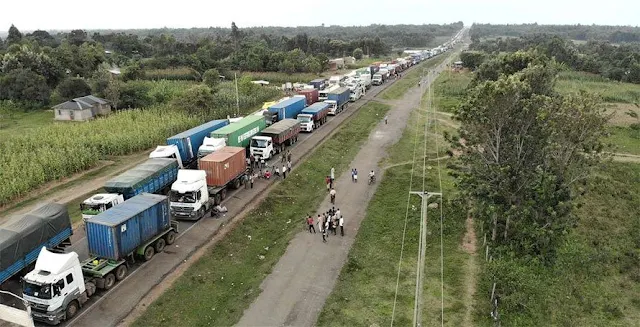
NAIVASHA INLAND CONTAINER STATION - KENYA, UGANDA PROTESTS


SUMMARY:

Kampala has protested Kenya’s move and wants use of Naivasha inland container depot to be optional.
Kenya moved the first consignment — a 200 20-foot equivalent units of cargo by Bolloré Transport and Logistics — direct from Mombasa to the standard gauge railway station at Suswa near Naivasha on May 7.

The Kenya Revenue Authority has since gazetted Naivasha ICD as a customs station, and announced on Tuesday it had started clearing transit cargo at the new transhipment station. Ugandans wants use of Naivasha inland container depot (ICD) to be optional.

Kampala has faulted Nairobi’s decision to move clearance of all transit cargo from Mombasa to Naivasha despite an array of incentives that include 30-day free storage period.

“The option of using Naivasha ICD for transit cargo would not reduce human traffic movement as truck drivers will still be required to pick the containers from Naivasha to their destinations,” said Gen Wamala in the letter, which he said followed consultations with Uganda’s private sector.

“It’s our considered opinion that the use of Naivasha ICD, which is part of our long-term regional infrastructure development, should remain optional.”

On Wednesday, however, Transport secretary James Macharia told the Business Daily that Kenya’s position was as a result of a decision reached during the May 12 virtual East African Community Heads of State Summit on measures to contain the spread of coronavirus.

Wednesday

DHL IN CHINA -AFRICA DEDICATED FLIGHT SERVICE


The Deutsche Post DHL, Global Forwarding has launched a dedicated 100-tonne weekly air freight service for organisations and governments shipping goods from China to Africa and Middle East.

This comes as a boost when most countries are grappling with how to transport cargo due to the grounding of most planes by airlines due to the deadly Covid-19 pandemic.

Capitalising on Dubai's strategic geographical location as the gateway to countries in the region, the international logistics giant will consolidate cargo from across China into Guangzhou and air freight them via Dubai to their various destinations across Africa and Middle East. Africa is Dubai's third largest trading partner in volume terms and Africa's non-oil trade with Dubai has been growing steadily over the last decade, accounting for 10.5 per cent of the emirate's total non-oil foreign trade in 2018.

Whilst the secured uplift from China will be in operation for four weeks starting April 21, DHL Global Forwarding is actively seeking to secure routes to all of Africa and boost capacity to the Middle East and Africa in the longer term.

DHL is the leading global brand in the logistics industry which offers range of logistics services ranging from national and international parcel delivery, e-commerce shipping and fulfillment solutions, international express, road, air and ocean transport to industrial supply chain management to more than 220 countries.

The Group generated revenues of more than $68 billion in 2019.

Saturday

OMAN LIVESTOCK IMPORT FROM SOMALIA


More than eighteen thousand sheep were brought to Salalah Port from Somalia on Wednesday in order to boost availability of food supplies.

A statement issued online by the Ministry of Agriculture and Fisheries said that 18,610 Somalian sheep were brought in to ensure that the supply of local and foreign food commodities to local markets continued without disruption.

“The veterinary quarantine procedures are being completed and the sheep are being examined to ensure their health safety and that they are free from any pathogens before their release," the statement added.

We can get some livestock for you from Africa especially Kenya, Somalia, Djibouti or Tanzania. Please send an email: africanshippingdubai@gmail.com or call/whatsapp +971 56 953 8569 or +254 726 722 226
  اغنام صـومـالـي  بيع جميع انواع المواشي والأغنام 🐐🐄🐏 جملة & مفرد تصدير إلى جميع دول الخليج العربي للاستفسار اتصل بنا على +971 56 953 8569

Wednesday

SOMALIA SET TO JOIN LIST OF PORT STATES


Somalia is set to join the list of port States for the first time after it completed development of Somali shipping code. The development of the code will enable the country to discharge its responsibilities as flag, port and coastal state.

Maritime development in Somalia announced the completion of the shipping code early this week after six years of work, supported by International Maritime Organisation (IMO) and the United Nations Assistance Mission in Somalia (UNSOM).

The shipping code will now undergo the final stage of parliamentary process for enactment into Somalia national law to ensure the necessary legal and administrative processes are in place which will be a major boost to the country’s growing blue economy opportunities. The shipping code is the blueprint for a country to accede all key IMO treaties, enabling the nation to meet its responsibilities in line with IMO instruments and to discharge its responsibilities as a flag, port and coastal State.

The development of the code was instigated in 2014, when Somalia requested IMO to help revise its previous (1959) maritime code. The country was then emerging from more than two decades of internal conflict and concerted international efforts to suppress and reduce acts of piracy off its long coastline.


The revised shipping code reflects “the most up-to-date best practices and developments in international maritime law”. The process of developing it has seen the establishment of the Somali Maritime Administration.

The IMO and UNSOM have worked with Somalia to deliver legal and technical training to support core administrative and legal functions, including induction training for maritime administration officials.

Early this month, Somalia’s Minister of Ports and Marine Transport, Maryam Aweys Jama, received a copy of the finalised Code (in the Somali language) from Dave Muli, IMO's regional coordinator for Eastern and Southern Africa. Mr Muli acknowledged Somalia’s commitment to ensuring safe shipping off its coast and pledged IMO's continuing support for the development of the maritime resources.

Somalia has longest coastline of more than 3,300km, the most geographically significant in the Horn of Africa. It has a number of commercial seaports and several minor ports which include Bosaso, Mogadishu, Barawa, Berbera, Marka, Kismayu among other small ports.