الخطوط الملاحية الأفريقية ASLINE - AFRICAN SHIPPING LINE - The World's Gateway to Africa...بوابة العالم إلى الموانئ الأفريقية ...Dünyanın Afrika Limanlarına Açılan Kapısı...世界通往非洲港口的门户......WEEKLY VOYAGES CONNECTING CHINA, MALAYSIA, THAILAND, INDIA, SRILANKA, PAKISTAN, DUBAI TO THE FOLLOWING AFRICAN PORTS : #MOMBASA #DARESALAAM #MOGADISHU #KISMAYO #BOSASO #BERBERA #DJIBOUTI #PORTSUDAN #NACALA #DURBAN #LUANDA #LOBITO #DOUALA #APAPA #TINCAN #LOME #TEMA #ABIDJAN #BISSAU #DAKAR

ASLINE - AFRICAN SHIPPING LINE DUBAI

Saturday

23,000 CMA CGM CONTAINER SHIP ENTERS MARKET

Ten days on and CMA CGM is still struggling to get all its systems back online but still the Mega Container Ship CMA CGM Jacques Saade Enters Service. 

First 23,000 TEU container vessel in the world to be powered by LNG

The CMA CGM JACQUES SAADE has joined CMA CGM Group’s fleet thus becoming the largest LNG-powered container ship in the world.

CMA CGM has made the symbolic choice of naming its new flagship after its founder, Jacques Saadé, a visionary and entrepreneur.

The joining of the fleet of the CMA CGM Jacques Saadé was marked by a first-of-its-kind digital naming ceremony that saw the shipyard’s representatives in Shanghai and CMA CGM Group’s management in Marseille share an emotional landmark moment in their common history.

ETHIOPIAN SHIPPING LINE TO BUY 2 NEW BULK VESSELS

The Ethiopian Shipping and Logistics Service Enterprise (ESLSE) is under preparation to buy two bulk-cargo ships.

Mekonnen Abera, director general of the Maritime Affairs Authority and board chairman of the Ethiopian Marine Transport and Logistics Services Enterprise, and Roba Megerssa, CEO of the enterprise, on Monday launched the project office that would oversee the procurement of the two ships. The enterprise said the project office has six members who have long years of experience. The project office will be responsible for the design of the ships and the selection of the shipyard that would build the new vessels.

The fleet that is operated by ESLSE has 11 ships with a total loading capacity of 400,000 tons of cargo. Two the ships are fuel tankers. Robe told The Reporter that the enterprise is preparing to float an international tender and invite companies with repeatable ship building experience to bid for the project. “The ships will be built in East Asia, most probably in China, Korea or Indonesia,” Roba said.

The ships will be built in the 2020-2021 budget year. Each ship will have 60,000 tons of bulk-cargo loading capacity. Roba declined to disclose the cost of the two ships saying that it would affect the bidding process.

The Ethiopian Shipping and Logistics Service Enterprise transported and handled 11 million tons of cargo in the 2019-2020 Budget Year, which ended on June. Out of the total, some 7 million tons was transported by ships. The enterprise that serves 330 ports leases ships with slot charter agreement from other carriers. The company transports 60 percent of the Ethiopia’s imports, every year. The enterprise generated about of 25.8 billion birr and earned a profit of 2.5 billion birr. The enterprise’s capital stands at 20 billion birr and plans to raise it to 80 billion birr.

Monday

CMA CGM IT SOFTWARE SITE DOWN - SOURCES

 CMA CGM has become the latest global carrier to be hit hard by IT issues with clients waking up this morning to find many of the brand’s global sites down.

In a note sent to clients in Australia, seen by Splash, CMA CGM and its local subsidiary ANL said some of its IT applications are unavailable today due to what the group described as an “internal IT infrastructure issue”.

The group’s emails are working as usual, the company said.


CMA CGM representatives in China, contacted by Splash today, said the company was aware of the sites being down and the company was looking into the issue.

“External access to CMA CGM IT applications are currently unavailable. IT teams are working on resolving the incident to ensure business continuity. We will keep you updated on the current situation,” a spokesperson at the group’s headquarters in Marseille told Splash today.

The spokesperson has yet to reply to widespread speculation that the IT outage originated at its China operations following a ransomware attack.

CMA CGM claiming an internal IT infrastructure issue does not necessarily mean the carrier has been hacked as other top carriers have in recent years. CMA CGM is the world’s fourth largest liner – the top three, Maersk, MSC and Cosco, have all suffered hacks in recent years, leading to massive losses.

Friday

MAJOR LINES EXPERIENCING CONTAINER SHORTAGES IN EXPORT PORTS

All the major carriers are experiencing equipment shortages at Asian ports with popular 40ft high cubes in particular short supply at Chinese depots.

Anecdotal reports suggest CMA CGM currently has a shortage of equipment at all of the main Chinese ports, while other carriers are advising of shortages at some docks and “near normal” availability at others. However, one Chinese forwarding source said equipment availability was more about “what you are prepared to pay”, with some lines introducing a “box priority fee”, payable at the time of booking.

And many carriers have introduced restrictions on the release of empty containers prior to the intended shipment.

For example, Hapag-Lloyd will now only release empty containers from its mainland China depots a maximum of eight days prior to the estimated arrival of the intended sailing. And with surprising robust export demand, particularly on the transpacific, expected to continue into the traditional slack season and beyond the Chinese Golden Week holiday, the equipment shortage looks unlikely to improve for some time. However, one carrier source told The Loadstar today the line was working “very hard” to resolve issues in Asia by repositioning as much equipment as possible.

Meanwhile, for the secondary tradelanes such as Latin America and Africa, where 20ft boxes are more commonly used, shortages are also an increasing concern for shippers. According to the xChange’s Container Availability Index (CAx), the availability of 20ft containers at Asian ports is “set to reach new lows in the coming weeks”.

It added: “If we have a look at the availability at Port Kelang, Malaysia, we see the availability of 20ft standard containers has seen an abrupt drop since week 36. Going from a value of 0.47 to 0.21 two weeks later.”

The CAx also indicated a reading of 0.27 for Shanghai for week 39. A CAx value above 0.5 indicates a surplus of equipment, a reading below suggests a deficit.

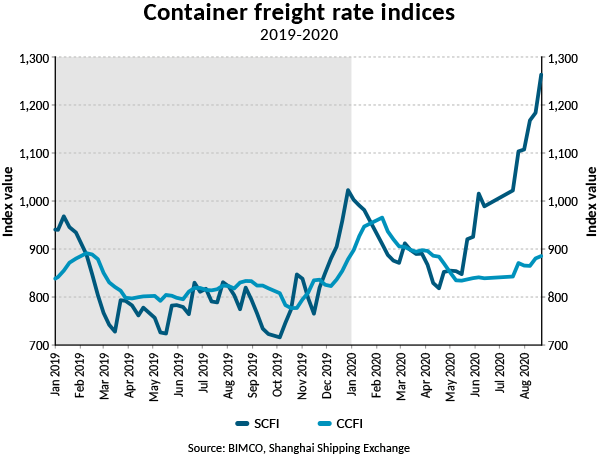
The shortage of equipment in Asia comes on top of rocketing spot rates on several tradelanes, especially from Asia to the US west coast, where after seven GRIs the current Shanghai Containerized Freight Index (SCFI) reading stands at an all-time record of $3,841 per 40ft, and looks set to break $4,000 before the month end.

Carriers are also hiking other fees, such as terminal handling charges in Europe, which has angered shippers that believe the lines are taking unfair advantage of a strong position.

“They are making them [surcharges] up as they go along”, one forwarder contact claimed to The Loadstar, after receiving a new advisory. 

Nevertheless, there is some sympathy for carriers that have seen demand from Asia confound all analyst predictions, while the pandemic still rages around the world.

“I’d usually be sceptical, but it would appear that the shortage of equipment is very real across all liners we’re speaking to and others that we hear through the grapevine, said UK-headquartered Westbound Logistics co-owner Ryan Clark.

“I actually asked the question, suggesting they would be giving away freight rates on the backhaul leg to get the boxes repositioned,” said Mr Clark, but the carrier’s response was ‘no, actually that’s the worst thing we need right now, as they all demand 14-21 days’ free time. It’s more profitable for us to ship empties back to get them loaded on the import sector again as quick as we can’.”

SHORTAGE OF CONTAINER EQUIPMENTS - CAUSING DELAYS IN SHIPPING

 A container shortage in India is causing long delays for exporters, especially on US trades.

Earlier this month, The Loadstar reported the operational impact from the creeping equipment shortage in Asia – dominant headhaul traffic has caused empties to pile-up at ports in the US and Australia, for example, prompting carriers to plead for the swift return of used import boxes.

According to New Jersey-based Worldwide Logistics (WL), the equipment shortage has spread to India, partly due to a drop in import volumes from China after trade restrictions were imposed by the government.

“The shortage is most critical at Inland Container Depots (ICD) but also evident at port-side locations,” the forwarder noted.

“Cargo volume from India to the US is extremely strong, as US importers look to replenish inventory depleted during the shutdown period in India, in response to Covid-19.”

WL said most direct and transhipment services to the US east and west coasts from the major gateway ports of Nhava Sheva (Mumbai) and Mundra were impacted, with transhipment further exacerbated by the tight space from Asian transhipment hubs.

“There is limited new container manufacturing in India which would otherwise serve to alleviate some of this pressure,” it added.

As a result, WL said carriers had begun to offer guaranteed space surcharges of US$750 per container, similar to the ‘no-roll’ premiums found on the deepsea trades over the past couple of months.

Rakesh Pandit, CEO of Conbox Logistics in India, agreed the container shortage was particularly acute at inland terminals.

“The shortages are bigger if shippers have to plan their cargo from dry-ports of central and western India,” he told The Loadstar.

“There is waiting period to get bookings and containers for one or two weeks on certain sectors, such as pharmaceutical companies who have to wait almost two weeks to get bookings for US ports.

“Shipments planned in large volumes like marble, rice and other agro commodities are also getting delayed,” Mr Pandit added.

He said the current ocean freight market was experiencing spiralling costs caused by shipping lines implementing increased surcharges, blank sailings and rolled cargo. For example, reefer rates to the US have increased 25%-30% to $4,000-$4,500, and, with further increases expected in October, the rate could soon breach $5,000.

“Shipping lines are also changing ocean freight rates very frequently – within seven days, instead of maintaining them for a month which was the case previously,” he explained.

Furthermore, he said there was a lack of government support for exporters rocked by lockdowns.

“Exporters are finding it hard to execute orders due to a lack of government support in the form of stimulus or financial aid. They’re also at the mercy of bankers, who aren’t supportive in the current market situation,” Mr Pandit claimed.

On the import side, he noted the market sentiment in India is very negative, with many businesses afraid the Covid situation will continue for another year.

“There is low demand for almost all products within India, so import growth will not be huge in coming months,” said Mr Pandit.

Indeed, according to the Indian Ports Association, port volumes between April and August plummeted 25% year-on-year to 3.2m teu. And, similar to India’s airfreight market, export volumes are gaining in share over imports.

Tuesday

CONTAINER SHIPPING LINES MAKING PROFIT UP - SECOND QUARTER 2020

 BEIJING—China’s export machine gained steam in August as countries gradually recovering from coronavirus lockdowns, including the U.S., snapped up more Chinese-made goods.

Outbound shipments from China rose 9.5% in August from a year earlier, beating July’s 7.2% increase and economists’ median forecast for 7.3% growth, data released by the General Administration of Customs showed Monday.


The container shipping industry posted a combined profit of $2.7bn in the second quarter of this year – every line publicly reporting financial results being in the black.

According to new research from liner analyst SeaIntelligence Consulting, the positive results were despite every line experiencing declining revenue and year-on-year volumes.

“Looking at the financial performance, the shipping lines have been able to navigate these uncertain times rather well,” said SeaIntelligence Consulting chief executive Alan Murphy.

“This has to be the result of a combination of cost-cutting and higher freight rates – nearly all carriers recorded a higher freight rate compared with the second quarter of 2019.”

Mr Murphy added that the second quarter was the first since 2010 in which all 10 carriers that publish financial results posted a positive ebit per teu, and revealed the surprising news that the formerly loss-making South Korean carrier, HMM, had made up substantial ground on the leading carriers.

While Hapag-Lloyd posted the highest profitability, at $146.40 per teu, HMM saw an ebit per teu of $129.10, marginally below Maersk’s $129.30 per teu. The least profitable carrier was Yang Ming, with $18.60 per teu, just below OOCL at $45.10 per teu and the latter’s parent company, Cosco, at $58.30 per teu.

“This is a very positive development for the shipping lines, as the pandemic did not impact container shipping to the extent initially feared,” said Mr Murphy. “Industry focus will likely now be on the third quarter, which is the peak cargo season.”

What remains open to question, however, is the extent ebit per teu was affected by the application of surcharges, which today were once more the subject of criticism from the UK’s British International Freight Association (BIFA).

China posted a trade surplus of $58.93 billion (Dh216.27bn) last month, compared with the poll’s forecast for a $50.5bn surplus and $62.33bn surplus in July.

China’s trade surplus with the US widened to $34.24bn in August from $32.46bn in July.

Thursday

USED SHIPPING CONTAINERS IN KENYA

 USED CONTAINERS FOR SALE : MOMBASA, NAIROBI - KENYA.

AFRICAN SHIPPING LINE - Port Logistics once again have Shipping Containers ready for quick sale, which are in Good Sea Worthy condition, in Nairobi, Mombasa in Kenya and Kampala Uganda

OVER 200 CONTAINER UNITS AVAILABLE in any one Shipment. All Rates are Negotiable and Clients are advised to Get a Receipt along with Certificates and CW Plates

Please Speak/Whatsapp Mr. Ibraheem on +254726722226/ + 97156 953 8569 Email: africanshippingdubai@gmail.com Website: www.africanshippingline.com 

N/B: Good discount given for bulk buyers and commissions given for referrals;

Used Shipping Containers 20ft and 40ft in Kenya, Mombasa and Nairobi 

20ft = $1100- $1600       

40ft =$2000-$2600 (Without Transport)

If transport is needed, we can provide at cost. 

Reefer Containers for Sale in Mombasa, Nairobi, Kenya

Reefers

Total Price in Mombasa

20ft = $6,700 - $7200

40ft = $8100- $9200 (Without Transport)

N/B: Good discount given for bulk buyers and commissions given for referrals;

Viewing and reserving a container/s with us is important. Our Depot Managers recommend earlier appointments for viewing and actual sale.

Terms of payment 

Bank to Bank Transfers with RTGS copy as proof of payment, and you get release order on confirmation of payment, Cheques accepted, but release Order issued upon funds receipt confirmation.

NB: 

All units, are Ex EU, legally owned, some with valid CSC plates and can be used for export, and sold with Inter-change, and all relevant documents, including, Invoice, receipt, and Condition Report, and we will undertake minor repairs, paint and Cleaning if required, and have sold over 2500 without a problem.

We also offer, leasing, storage units, and transport at very discounted rate, and Container modification, to accommodation units, shops,

Toilets & washrooms, living quarters, according to customer demand (Transport empty containers @ Ksh 50K -Mombasa – Nairobi per truckload)

Email: africanshippingdubai@gmail.com 

Sunday

SAUDI'S BAHRI البحري INKS $410 MILLION TO BUY BUILD NEW CHEMICAL TANKERS WITH HYUNDAI HMD

Saudi national shipping carrier Bahri has signed a $410 million deal with manufacturing giant Hyundai Mipo Dockyard (HMD) to build 10 medium-range chemical tankers.

The agreement between Bahri البحري a global leader in logistics and transportation, with HMD was inked for the construction of 10 chemical tankers  on the range of 49,999-dwt (measure of how much weight a ship can carry) vessels.

With deliveries scheduled to start during the first quarter of 2022, the 10 chemical tankers will be built to the highest environmental, fuel-efficiency, and safety standards in line with the company’s commitment to operating responsibly. 

The agreement was signed recently at a virtual ceremony, between Mr. Abdullah Aldubaikhi, CEO of Bahri, and Seung-Yong Park, COO and Senior Executive Vice President of HHI.


“The new agreement with HMD for the building of 10 high-spec chemical tankers represents a major step forward in our next phase of growth and further strengthens our leading position in the global maritime industry. With the newbuilds entering our fleet over the next two years, we will be further equipped to cater to the varying needs of our customers around the world,” Abdullah Aldubaikhi said.

Park from HHI commented: “These 10 MR tankers will bring the tally of various types of vessels that we built for Bahri to 61. We are committed to ensuring that our long-standing partner receives high-quality and eco-friendly vessels this time as well, and sincerely hope this project further strengthens our concrete relationship with one of the most renowned shipping companies.”

Bahri owns and operates a total of 87 vessels, including 41 VLCCs, 34 chemical and product tankers, 6 multipurpose ro-ro vessels, and 6 dry-bulk carriers, in addition to four other carriers on order.


Saturday

CONTAINER LINES MAKING MONEY IN ADVERSITY with MAERSK MAKING $1.7 BILLION IN Q2 2020

 The second quarter financial reporting season is in full swing and container lines results rather than being the expected bloodbath with statements full of red ink are in general actually more profitable than they were a year ago.

The Covid-19 pandemic has pummelled world trade, especially in the second quarter as large swathes of the globe went into lockdown, the result of which would be expected disaster for consumer dependent container lines But the Q2 figures published by listed container lines reveal a very different story, yes volumes and to a lesser extent revenues are down, but profitability is up.

The biggest of them of all, AP Moller – Maersk, reported an EBITDA increase of 25% to $1.7bn in Q2 2020 compared to $1.4bn a year earlier, primarily driven by an improvement in its core ocean sector - Maersk Line. This was despite volumes for this business dropping by a substantial 16%.

Hapag-Lloyd reported a first half EBIT for 2020 of $563m, up from $440m in the same period a year earlier. “On the whole, we have a good first half year behind us despite the coronavirus crisis,” commented Rolf Habben Jansen, ceo of Hapag-Lloyd.

Japanese joint venture Ocean Network Express (ONE), which has struggled since its inception, reported a $167m profit for its first quarter ended 30 June, compared to just $5m in the same period a year earlier. This was despite ONE noting a 20% dip in cargo demand year-on-year in the quarter.

South Korea’s HMM, Hyundai Merchant Marine which had raised more than a few eyebrows starting to deploy a series of 24,000 teu newbuildings – the largest ever – in the middle of a global pandemic, was also profitable. It bounced back to the black with a KRW28.1bn ($23m) profit in Q2 2020 compared to a KRW200.7bn loss in the same period in 2019.

Meanwhile ZIM reported a net profit of $25.3m in Q2 2020, it’s highest quarterly net result since 2010, and compared to a $5.1m profit in Q2 2019.

The biggest factor in these positive results has been the ability of lines to manage capacity thereby keeping up utilisation rates and avoiding the sector’s seeming penchant for value destroying market share battles.

Blank sailings have been key with April and May seeing the peak of lines pulling out services on major trade lanes. Week 17 of 2020 for example saw a 38% drop in a capacity the Asia – Europe trade for example, according to analysts Sea Intelligence. It is not just the scale of capacity cuts, but also the speed and agility with which lines have acted, enabling effective utilisation rates to be sustained on major trades.

On top of this lower bunker prices, given the collapse in the oil price, also significantly helped the operating cost bases of container lines.

It’s worth noting that the counter-cyclical improvement in profitability did come a bit too late for some, and top 10 container carrier Pacific International Lines (PIL) is in the process of negotiating a financial bailout with Singapore state-owned Temasek Holdings.

The question is though can rational management of capacity be sustained? Despite the caveats about uncertainties and Covid-19 second waves the financial forecasts of lines would suggest they believe the answer is yes.

Maersk reinstated earnings guidance for 2020, suspended in March due to the uncertainties caused by the Covid-19 pandemic. The new guidance of an EBITDA of $6bn - $7bn for 2020 is higher than its guidance of $5.5bn prior to suspension. Hapag-Lloyd kept its forecast for the year at an EBITDA of EUR1.7 to 2.2bn and an EBIT of EUR0.5 to 1.0bn.

ONE though was rather more cagey though on the outlook saying: “Forecasting FY2020 performance reasonably is still difficult and therefore FY2020 full-year forecasts are not yet fixed.”

The way in which lines, and the alliances they are in on the major trades, manage capacity is going to come under increasing scrutiny given shipper allegations of profiteering, in particular on the transpacific trade. The US Federal Maritime Commission (FMC) is reported to be keeping a close watch on blank sailing announcements by lines and alliances on trades to the US, and China’s Ministry of Transport is reported to have sent letters to the six largest container lines asking for explanations to the recent surges in freight rates.

It is certain the management of capacity by container lines, freight rates, and the next quarter’s financial results are all going to be watched very closely to see if box shipping’s turnaround in adversity can be sustained.

Wednesday

ASLINE-非洲运输公司中国将处理您从中国到非洲的所有运输


您的运输集装箱是我们的优先事项。我们提供#AfricanShippingLine #ShippingToAfrica第一和快速。与领先的非洲航运公司合作,在迪拜,中国,印度,土耳其为集装箱运输,杂货运输,项目运输,车辆运输提供服务,以最快的速度向所有非洲国家和其他相连港口交付货物。

进料线,集装箱和滚装运输和货运物流服务:
1.东非

2.南非

3.西非

从迪拜,中国,印度,土耳其到吉布提,贝贝拉,博萨索,摩加迪沙,基斯马伊,蒙巴萨,达累斯萨拉姆,纳卡拉,德班以及阿帕帕,丁干,洛美,特马,阿比让和达喀尔的每周运输。

办公地点:
迪拜海关,拉希德港
AlFardha大楼#29
阿联酋布尔迪拜
+ 971-56-9538569
+ 254- 726- 722226
电子邮件:asline@africanshippingline.ae

Whatsapp:+ 971-56-9538569
通用电子邮件:africanshippingdubai@gmail.com
网站:www.africanshippingline.com

Thursday

GAC ACQUIRES - BUYS AHLER'S SINGAPORE CONTAINER LOGISTICS UNIT


GAC has penned a memorandum of understanding to acquire the container logistics unit of the Singapore subsidiary of Belgium-based Ahlers. GAC said the acquisition of Ahlers Singapore’s container logistics business unit will help the group boost its foothold in Asia and enhance its service portfolio.

Henrik Althen, managing director of GAC Singapore, said that the container logistics business will give the company even greater control over the entire supply chain. “Container logistics are an integral part of the supply chain solutions we offer to our customers. It complements our sea freight and contract logistics services, giving us the expanded bandwidth and enhanced capability to look after the entire supply chain more efficiently and effectively,” Althen said.

Carla Peeters, cfo of Ahlers Group, said the transaction is part of the company’s increased focus on its core activities in Europe, Russia and CIS where it has “important investment projects ongoing.”

Lars Bergstrom, group vice president of GAC’s Asia Pacific and Indian Subcontinent region, said: “It’s a great match, as both companies focus on creating innovative and value-adding solutions to our customers. Agility and innovation are key to survival in the highly competitive logistics industry.”

Sources: Seatrade Maritime

KENYA & TANZANIA MARITIME AUTHORITIES EXTEND FREE PERIOD FOR EMPTY CONTAINERS

Kenya Maritime Authority (KMA) has waived storage fees for empty containers held in various state holding facilities since June 1 this year, giving a reprieve to local and regional importers.
The state agency said the waiver was agreed after it was established that importers were affected by the challenges of Covid-19.

After the cargo is delivered to the final destination, an empty container should be returned to the shipping line within a free period of 14 days for local and 45 days for transit cargo.


KPA offers a seven-day free storage fee for empty containers before it starts to levy Sh1, 500($15) for a 20-foot and Sh2, 200 ($22) for a 40-foot container until it is removed from its depots. The move to backdate the extension of the free period means importers will now enjoy over two months free period. Last week, KMA announced that it had given seven days free period for transit cargo and three days for local cargo respectively being moved along the Northern corridor with effect from July 1 this year.

In a letter to shipping agents dated June 10 this year, TASAC director-general Mr. Emmanuel Ndomba also cut down the free period for containers destined to Zambia from 40 days to 50 days in the new arrangement. He halted the use of the storing order on receiving/returning empty containers with immediate effect to improve the availability of equipment and trucks.

Monday

PORT INFORMATION: DAKAR PORT TERMINAL - SENEGAL


Position – Lat. 14° 40' 56” N   Long. 17° 25' 48” W

Container Terminal
The container terminal is run by DP World; there is also a multipurpose terminal (GETMA) which also handles containers. A private line runs part of the Ro Ro Terminal.

Hours of Operation (Vessel and Gate)
Continuous loading and unloading: 24 hours per day 7 days per week
Berthing: 24 hours per day

Berth Information
There are two main quays, one for Ro-Ro and Multipurpose cargo (Southern Quay) and the other is the DP World terminal (Northern Quay). Information provided is for the DP World container terminal.
Length of Quay: two of 424m
Concession signed between the Port of Dakar and DP World for the construction of a new terminal with a capacity of 1.5 million TEUS.
Draught: 13m
Number of Berths: 3

Yard Information
Total Yard Square: 21 hectares
Number of Reefer Plugs: 400
Full storage Container Capacity: Annual capacity in excess of 600,000
TEU (Dakar Port Authority website)

Equipment
Wharf Gantry Cranes: 4
Gottwald Cranes on tyres: 4
Yard Granty Cranes: 10
Reach Stackers: 15 (Dakar Port Authority website)
Storage Areas
A new logistics facility at the port with a total surface area of 210,000m², of which 40,000m2 is covered , with 750 parking spaces for trucks. One inland container depot run by TCD (Terminal Conteneurs Dakar) is located in vicinity with a second one planned, and are owned by CMACGM Group. There are also Senegalese Warehouses in Mali covering a surface of 6 ha. There are 12 storage warehouses and 2 Reefer warehouses, storage space for construction material, loading and unloading quays for trucks and trains and handling equipment. Road network connections for cargo bound traffic for Guinea-Bissau, Mauritania, and Gambia. With its onsite rail terminal, Dakar Port is the main gateway to Bamako, Mali. )

Port Authority Contact Details
Port Autonome de Dakar
Address: Port Autonome de Dakar 21, Bd de la Libération, BP 3195 Dakar, Sénégal

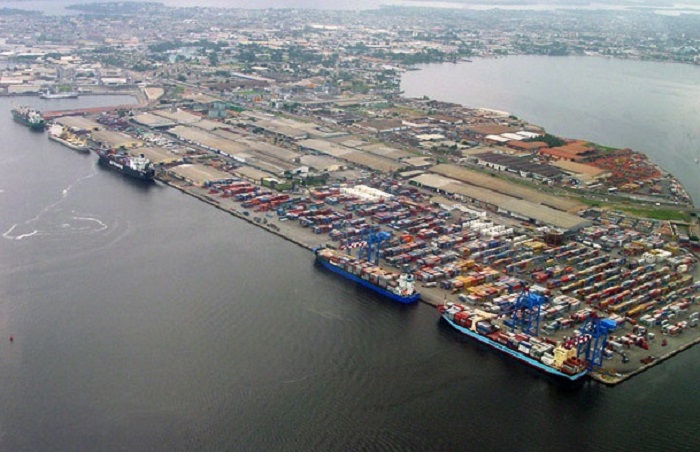
PORT INFORMATION : ABIDJAN PORT - IVORY COAST COTE DE IVOIRE

Position – Lat. 5° 17' 0” N   Long. 4° 1' 26” W

Container Terminal
The port of Abidjan is located on a lagoon and is connected to the sea by a 2.8 long km channel which has a depth 13m. SETV, Abidjan Container Terminal. The terminal is run jointly by Local Logistics [60%] and APM Terminals [40%]


Hours of Operation (Vessel and Gate)
Continuous loading and unloading: 24 h/24, 365 days per year
Berthing: 24/7 (Bolloré website).

Berth Information
Quay: Purpose: Length: Draught:
North Quay General Cargo 775m/quay 9.45m
West Quay General Cargo 1525m/quay 9.45m
South Quay Container > 1.785m/quay 11m
South Quay Container 390m/quay 11,50m
South Quay Container max LOA 190m 11,50m
Number of Berths: 5

Yard Information
Total Yard Square: 31 hectares
Number of Reefer Plugs: 456
Full storage Container Capacity: 20,000 TEU
Generators (in case of emergency): 2
Port Authority Contact Details
Website: www.portabidjan.ci
Address: Immeuble du port, BP V85 Abidjan
Tel: +225 21 23 8000
Fax:+225 21 23 8000

Saturday

VENTURE CAPITALISTS HAVE FOUND ANOTHER TRILLION DOLLAR MARKET TO INVEST: SHIPPING


Software Like Newer companies including Facebook, Twitter, Instagram may be eating the world, but some industries have been off the menu. Now, international shipping’s time has come. 

The UN estimates at least 90% of the world’s physical goods end up in a shipping container before arriving at their destinations. Until recently, shippers have conducted much of their business as they have for decades: using spreadsheets, emails, and phone calls.

Those days are drawing to a close. Last year, venture investors backed more than 245 startups in shipping and supply-chain management, a record number worth at least $4 billion, reports business intelligence firm CB Insights. AngelList tracks 420 shipping startups (not all international), as well as hundreds more in logistics and supply-chain management.


While domestic logistics is being rapidly transformed by robotic warehouses, autonomous trucks, and on-demand services such as Uber, DoorDash, and Amazon Prime, the unglamorous world of international freight has remained largely a rolodex affair. A single shipping transaction may involve 28 different entities including customs, terminals, forwarders and carriers, reports Lloyd’s List, a marine intelligence firm. Many of these interactions still happen by email, phone and manual data entry, generating reams of paperwork. Startups spy an opportunity.

 ”Our competition is [Microsoft] Excel and email,” says Renee DiResta, co-founder and director of marketing at logistics startup Haven which builds software to replace today’s workflow. Haven, which raised $13.8 million in venture capital, is automating a quoting, booking, and shipping process in which setting a price for customers can take days. By accessing data about trillions of dollars in goods shipped around the world, Haven plans to help create an open, transparent shipping market that can be automated and optimized with machine learning.

The industry, long fixated on building bigger ships, is now turning its attention to the back office and customer experience. But designing new technology has proved challenging. In 2011, DHL spent $1 billion modernizing its own freight forwarding software, a failed effort that had to be written off four years later. Such efforts are nothing new.