
ASLINE - AFRICAN SHIPPING LINE DUBAI

Friday
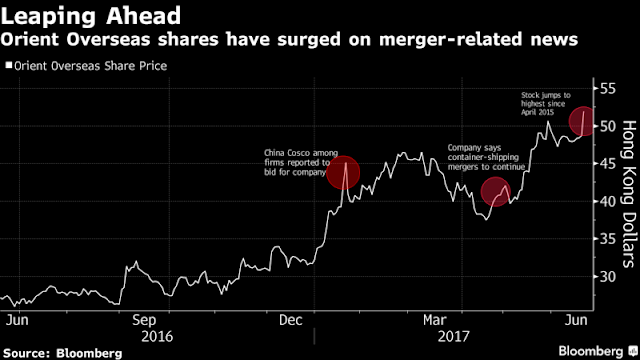
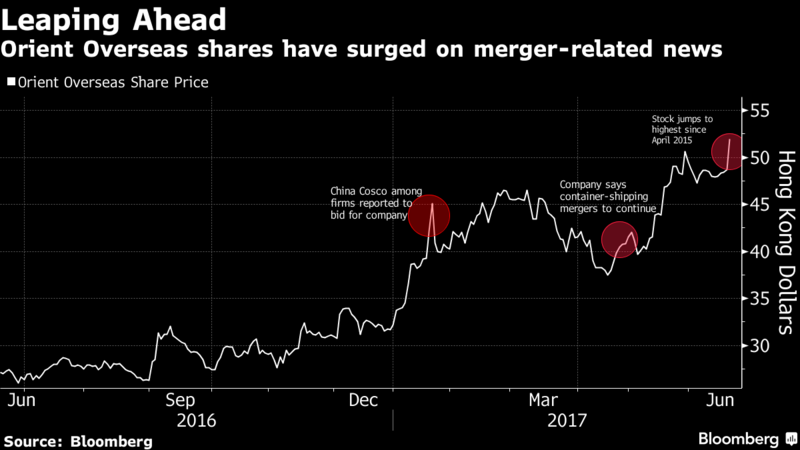
COSCON BUYS OOCL FOR USD 6.3 BILLION & OOCL STILL KEEPS BRAND
Chinese shipping line, unit make offer at HK$78.67 per share
Controlling shareholders Tung family have agreed to sell
Cosco Shipping Holdings plans to buy Orient Overseas Container Line (OOCL) with the help of Shanghai International Port Group (SIPG) for $6.3 billion, in a deal that would maintain the Hong Kong carrier’s brand and marks a new chapter in ongoing industry consolidation.
The deal, subject to regulatory approvals, culminates long-running speculation that Cosco would purchase OOCL, a carrier seen by some analysts as the only attractive takeover target of substantial size remaining in the market following rapid carrier consolidation over the past year and a half.

The combined Cosco Shipping, a subsidiary of Cosco Shipping Holdings, and OOIL would have a fleet of more than 400 ships and a total capacity of 2.9 million TEU including the orderbook. Together, Cosco and OOCL would operate the third-largest mega-ship fleet and be the second-largest mover of US containerized goods would be created, according to an analysis of PIERS data and the IHS Markit orderbook.
Under the deal, OOIL would keep its Hong Kong corporate headquarters and the independent share listing. It would also put off any headcount reductions at OOIL for at least 24 months, Cosco said in a statement. Cosco acknowledged the separate and distinct culture that has led OOCL to become of the industy’s best performing and highest regarded carrier in the eyes of BCOs, and clearly indicated that was an important part of the value it was acquiring.
“We respect OOIL’s management team and its expertise, not to mention its people, brand and culture,” said Wan Min, chairman of Coscol Shipping Holdings.
By leveraging the strengths of each company and achieving synergies, the businesses aim to enhance their operating efficiencies and competitive positions to achieve sustainable growth in the long term. Both companies are members of the Ocean Alliance, and will continue to work together under this framework.
“We are proud of the business we have built and the people who have been building it. This decision has been carefully considered and we believe it helps ensure the future success of OOIL. We are confident that Cosco Shipping Holdings is the right partner for us,” OOCL CEO Andy Tung said Sunday.
It came as little surprise that Cosco would maintain OOCL as a standalone brand. OOCL is known for a high quality of service relative to many of its competitors, as well as strong BCO relationships, and CMA CGM and Maersk Line have maintained the APL and Hamburg Sud brands, respectively, after their acquisitions. Given legacy cultural differences — Cosco being a Beijing state-owned enterprise and OOCL a fully commercial, standalone business — a full integration would be seen as extremely difficult. Even prior to the acquisition, Cosco and OOCL were drawing increasingly closer particularly in their participation in the Ocean Alliance.
The deal continues what has been a breakneck pace of consolidation in container shipping and raises further questions about the surviving carriers’ ability to parlay that concentration into pricing power. Rates overall have been on the upswing this year, but that can be easily attributed to capacity dislocations as the new alliances phased into service in April, as well as accelerating trade growth driven in part by Europe's economic recovery, the sustained US recovery, and economic growth in many developing markets, bolstering the slowing but largely uninterrupted growth in China.
Given carriers’ history of predatory rate wars with the ultimate — in some cases overtly stated — purpose of knocking competitors out of a market or out of business entirely, a cultural shift by carriers into an oligopoly environment will not occur overnight or easily, especially under the harsh gaze of antitrust regulators, principally in the United States and Europe.
In maritime analyst Drewry’s analysis of rates across the first half of the year, it found that its Global Freight Rate Index across a wide spectrum of trades was 36 percent higher after six months of 2017 versus the same period in 2016. However, Drewry did note that last year was exceptionally poor for carriers trying to secure compensatory rates, and when compared with the first half of 2015, spot rates for the first six months of 2017 were still 4 percent lower.
Nevertheless, rate increases on the spot market have been more muted in the eastbound trans-Pacific, where spot rates are up 33 percent from last summer, compared to the Asia-Europe trade lane, where the increase is 61 percent. Other, smaller trade lanes such as Asia to Brazil have seen huge increases in recent months.
There is little evidence thus far that industry concentration by itself is has translated into any kind of unspoken truce by carriers in pricing. But that said, carriers’ vessel ordering has slowed significantly and industry analysts are predicting that by 2019 the market could turn decisively in carriers’ favor, again not due to concentration by itself, but rather a slowdown in capacity additions combined with stronger trade growth driven by healthier economies in Europe and North America, and a steadily growing middle class in China.
Cosco, for example, earlier this month told its investors they can expect a $272 million profit for the first half, turning around a $1 billion loss recorded in the first six months of last year as the carrier benefits from rising container volume and freight rates. Cosco said its average freight rates in the container shipping business increased in the first half year over year, with cargo volume growing by 34.72 percent, driving up profitability.
OOCL reported a $273 million loss in 2016 as weak freight rates dragged down the average revenue per TEU by almost 19 percent to just $774 per container. Although it did not disclose earnings for the first quarter, Cosco on April 28 reported volume rose 7 percent year over year, while revenue increased 6.4 percent, to $1.18 billion. Overall revenue per TEU, however, slipped 0.6 percent from first-quarter 2016.
Controlling shareholders Tung family have agreed to sell
Cosco Shipping Holdings plans to buy Orient Overseas Container Line (OOCL) with the help of Shanghai International Port Group (SIPG) for $6.3 billion, in a deal that would maintain the Hong Kong carrier’s brand and marks a new chapter in ongoing industry consolidation.
The deal, subject to regulatory approvals, culminates long-running speculation that Cosco would purchase OOCL, a carrier seen by some analysts as the only attractive takeover target of substantial size remaining in the market following rapid carrier consolidation over the past year and a half.

The combined Cosco Shipping, a subsidiary of Cosco Shipping Holdings, and OOIL would have a fleet of more than 400 ships and a total capacity of 2.9 million TEU including the orderbook. Together, Cosco and OOCL would operate the third-largest mega-ship fleet and be the second-largest mover of US containerized goods would be created, according to an analysis of PIERS data and the IHS Markit orderbook.
Under the deal, OOIL would keep its Hong Kong corporate headquarters and the independent share listing. It would also put off any headcount reductions at OOIL for at least 24 months, Cosco said in a statement. Cosco acknowledged the separate and distinct culture that has led OOCL to become of the industy’s best performing and highest regarded carrier in the eyes of BCOs, and clearly indicated that was an important part of the value it was acquiring.
“We respect OOIL’s management team and its expertise, not to mention its people, brand and culture,” said Wan Min, chairman of Coscol Shipping Holdings.
By leveraging the strengths of each company and achieving synergies, the businesses aim to enhance their operating efficiencies and competitive positions to achieve sustainable growth in the long term. Both companies are members of the Ocean Alliance, and will continue to work together under this framework.
“We are proud of the business we have built and the people who have been building it. This decision has been carefully considered and we believe it helps ensure the future success of OOIL. We are confident that Cosco Shipping Holdings is the right partner for us,” OOCL CEO Andy Tung said Sunday.
It came as little surprise that Cosco would maintain OOCL as a standalone brand. OOCL is known for a high quality of service relative to many of its competitors, as well as strong BCO relationships, and CMA CGM and Maersk Line have maintained the APL and Hamburg Sud brands, respectively, after their acquisitions. Given legacy cultural differences — Cosco being a Beijing state-owned enterprise and OOCL a fully commercial, standalone business — a full integration would be seen as extremely difficult. Even prior to the acquisition, Cosco and OOCL were drawing increasingly closer particularly in their participation in the Ocean Alliance.
The deal continues what has been a breakneck pace of consolidation in container shipping and raises further questions about the surviving carriers’ ability to parlay that concentration into pricing power. Rates overall have been on the upswing this year, but that can be easily attributed to capacity dislocations as the new alliances phased into service in April, as well as accelerating trade growth driven in part by Europe's economic recovery, the sustained US recovery, and economic growth in many developing markets, bolstering the slowing but largely uninterrupted growth in China.
Given carriers’ history of predatory rate wars with the ultimate — in some cases overtly stated — purpose of knocking competitors out of a market or out of business entirely, a cultural shift by carriers into an oligopoly environment will not occur overnight or easily, especially under the harsh gaze of antitrust regulators, principally in the United States and Europe.
In maritime analyst Drewry’s analysis of rates across the first half of the year, it found that its Global Freight Rate Index across a wide spectrum of trades was 36 percent higher after six months of 2017 versus the same period in 2016. However, Drewry did note that last year was exceptionally poor for carriers trying to secure compensatory rates, and when compared with the first half of 2015, spot rates for the first six months of 2017 were still 4 percent lower.
Nevertheless, rate increases on the spot market have been more muted in the eastbound trans-Pacific, where spot rates are up 33 percent from last summer, compared to the Asia-Europe trade lane, where the increase is 61 percent. Other, smaller trade lanes such as Asia to Brazil have seen huge increases in recent months.
There is little evidence thus far that industry concentration by itself is has translated into any kind of unspoken truce by carriers in pricing. But that said, carriers’ vessel ordering has slowed significantly and industry analysts are predicting that by 2019 the market could turn decisively in carriers’ favor, again not due to concentration by itself, but rather a slowdown in capacity additions combined with stronger trade growth driven by healthier economies in Europe and North America, and a steadily growing middle class in China.
Cosco, for example, earlier this month told its investors they can expect a $272 million profit for the first half, turning around a $1 billion loss recorded in the first six months of last year as the carrier benefits from rising container volume and freight rates. Cosco said its average freight rates in the container shipping business increased in the first half year over year, with cargo volume growing by 34.72 percent, driving up profitability.
OOCL reported a $273 million loss in 2016 as weak freight rates dragged down the average revenue per TEU by almost 19 percent to just $774 per container. Although it did not disclose earnings for the first quarter, Cosco on April 28 reported volume rose 7 percent year over year, while revenue increased 6.4 percent, to $1.18 billion. Overall revenue per TEU, however, slipped 0.6 percent from first-quarter 2016.
Wednesday
NYK LINE, MOL, K-Line MERGER TO FORM OCEAN NETWORK EXPRESS REJECTED
 The South African Competition Commission has rejected the merger of the container divisions of NYK, MOL and K Line to create Ocean Network Express.
In South Africa, NYK operates its shipping business through the Mitchell Cotts Maritime agency; MOL through subsidiaries MOL South Africa and MOL ACE South Africa; and K Line though K Line Shipping South Africa.
The SA commission judged that on the evidence of past collusion between container shipping firms, the merger would have led to an increased likelihood of further anti-competitive behaviour.
“The commission has found that the structure of the container liner shipping market is conducive to coordination, based on previous collusive conduct in the container liner market in other parts of the world.
“The merger increases the likelihood of coordination as it creates further structural linkages in the container liner market,” it said.
While the creation of Ocean Network Express was solely limited to the shipping companies’ container businesses, the commission also looked at whether it would affect the car-carrying business, especially after the car-carrying divisions of all three were found to be part of price-fixing cartel, which also included Hoegh, Walenius Wilhelmsen, EUKOR and CSAV, in the inbound US trade.
“The commission also found that the proposed transaction creates a platform for coordination in the car carrier market which has a history of collusion involving the merging parties. The parties have been prosecuted in some jurisdictions, while investigations are underway in others. It is the commission’s view that the merging parties may require a formal mechanism for the further collusive conduct in the car carriers market. The joint venture provides such a mechanism.

“The commission is of the view that the proposed transaction is likely to increase the scope for coordination in the container liner shipping market, while creating a platform for coordination in the car carrier market.
“The commission further found that there are no efficiencies that outweigh the anticompetitive effects of this transaction and that there are also no remedies sufficient to address these effects,” it said.
The proposed Ocean Network Express also continues to await a decision from the US. Last month, the Federal Maritime Commission (FMC), to which the lines had submitted their merger proposals, decided it could not rule on mergers, as they are de facto acquisitions.
FMC chairman Michael Khouri said: “The Shipping Act expressly excludes acquisition agreements from the act’s coverage. The cases that address the commission’s authority to review these types of agreements have noted that Congress gave the commission the power to review cooperative agreements that produce efficiencies, in order to prevent consolidation.
“This proposed agreement is not the type of arrangement in which the parties would surrender control over a particular matter for the duration of the agreement but maintain their separate identity and original independence in the same line of business in all other respects. Thus, the commission has determined that the creation of the joint venture, including the pre-consolidation cooperation intended to facilitate and permit its creation, falls outside the commission’s jurisdiction.”
MAERSK IN CYBER ATTACK

Ukraine’s government, its National Bank and large power companies have also been affected, as has Russian oil company Rosneft, and Kiev Airport.
The airport noted: “Our IT services are working together to resolve the situation. There may be delays in flights due to the situation… The official site of the airport and the flight schedules are not working.”
According to media reports, companies are receiving a ransomware note in English, demanding $300 in Bitcoin, similar to the recent WannaCry ransom.
Maersk Line UK informed customers via Twitter in the morning that: “Unfortunately our computer systems here in the U.K. & Ireland are down. Our phone systems are live and we’re on hand to answer any Q’s.” It only admitted to a cyber attack several hours later. Subsidiary Damco’s website appeared to be working normally, however.

Tuesday
MV THERESA ARCTIC SALVAGE UNDERWAY IN KENYAN COAST : KILIFI
Product tanker THERESA ARCTIC ran aground on reefs in the afternoon June 20, in position 03 39S 039 53E, off Kilifi port, Kenya, north of Mombasa Port of Kenya. Vessel loaded with 27500 tons of vegetable oil was en route from Port Klang Malaysia to Mombasa, says Andrew Mwangura, Mombasa.
As of June 26, vessel was still aground, Smith Salvage and local company Alpha Logistics contracted for salvage, four tugs were already deployed, but reportedly, lightering is required. No information on hull breaches and leak, understood no leak yet. Crew remained on board.
Understood on a photo from The Star Kenya grounded THERESA ARCTIC.

Product tanker THERESA ARCTIC, IMO 8715508, dwt 84040, built 1988, flag Tuvalu, manager (according to AIS) RAFFLES SHIPMANAGEMENT SERVICES PRIVATE LTD, Singapore.
As of June 26, vessel was still aground, Smith Salvage and local company Alpha Logistics contracted for salvage, four tugs were already deployed, but reportedly, lightering is required. No information on hull breaches and leak, understood no leak yet. Crew remained on board.
Understood on a photo from The Star Kenya grounded THERESA ARCTIC.

Product tanker THERESA ARCTIC, IMO 8715508, dwt 84040, built 1988, flag Tuvalu, manager (according to AIS) RAFFLES SHIPMANAGEMENT SERVICES PRIVATE LTD, Singapore.
Tuesday
QATAR BEING SERVED BY MAERSK, MSC FEEDER FROM SALALAH (OMAN)
Hundreds of containers on their way to Qatar from Oman
A Qatari food company owner said shipments began arriving on Sunday from Oman, and that about 12 vessels were headed to Qatar from Sohar and Salalah.
"There are around 300 containers of fresh and frozen food coming. Some have arrived and the others are on their way," Ahmed al-Khalaf said.
He said containers at Jebel Ali port of the United Arab Emirates were still stuck, but that others, including from Europe, were being diverted to Oman's ports.
The world's number 1 container line, Maersk of Denmark, said on Monday it would accept new bookings for container shipments to Qatar from Oman.
Swiss-based MSC, the world's number 2 line, said it would deploy a new dedicated shipping service to Qatar from Salalah.

Last week, Qatar Ports Management launched a new direct service linking Hamad port in the Qatari capital with Sohar Port in the Sultanate of Oman.
At a press conference held at Hamad Port, Qatar Ports Management said: "In light of the recent developments in the region, Mwani Qatar (Qatar Ports Management) and its partners have ensured the business continuity of its ports and shipping operations in and out of Qatar to mitigate the impact of any action that would affect the imports and exports to and from the country."
The service will operate three times a week and journey's will take up to one and a half days.
In an advisory released Sunday, the UAE’s transport authority suggested that the Emirates no longer bars non-Qatari vessels that are engaged in Qatari trade from entering UAE ports – an important development in the ongoing dispute, as the Emirates’ Port of Fujairah is home to the region’s main bunkering facility.
“This notice differs in substance to notices which have been issued by some of the ports within the UAE during the course of the last week,” commented law firm Ince & Co. in a client advisory. “Of particular relevance is the fact that there is no reference to vessels not being given port clearance if the last port of call or next port of call is Qatar, This could mean that vessels which have loaded in Qatar and wish to bunker in Fujairah may be able to do so.”
The announcement still forbids UAE ports from handling any cargo of Qatari origin, receiving any Qatari-owned or -flagged vessel, or loading any cargo of UAE origin bound for Qatar. The transport authority called on “those concerned to implement strictly .”

The Qatar Ports Management Company announced Sunday that it has initiated two new container services between the Omani ports of Sohar and Salalah and Hamad Port, Qatar. The UAE’s shipping ban has stranded thousands of Qatari containers in the Emirates, as most normal transshipment services to and from Hamad are routed through Jebel Ali and Khalifa Port. The new substitute feeder routes from Oman will each run three times a week. Maersk Lines, Evergreen, OOCL and COSCO had all announced service suspensions to Qatar and stopped accepting shipments bound for Hamad Port.
With transshipments routed through Oman, Maersk has since resumed all normal operations; in a statement Monday, number two carrier MSC proudly noted that it never stopped accepting consignments, unlike competitors.
The new feeder services will ease pressure on Qatar’s supplies of fresh and frozen food, which the tiny nation of three million obtains through imports. Iran and Turkey have been flying provisions into Doha as an emergency measure, but with a sea route reopened, at least 300 containers of food supplies are now on their way, trader Ahmed al-Khalaf told Reuters.
A Qatari food company owner said shipments began arriving on Sunday from Oman, and that about 12 vessels were headed to Qatar from Sohar and Salalah.
"There are around 300 containers of fresh and frozen food coming. Some have arrived and the others are on their way," Ahmed al-Khalaf said.
He said containers at Jebel Ali port of the United Arab Emirates were still stuck, but that others, including from Europe, were being diverted to Oman's ports.
The world's number 1 container line, Maersk of Denmark, said on Monday it would accept new bookings for container shipments to Qatar from Oman.
Swiss-based MSC, the world's number 2 line, said it would deploy a new dedicated shipping service to Qatar from Salalah.

Last week, Qatar Ports Management launched a new direct service linking Hamad port in the Qatari capital with Sohar Port in the Sultanate of Oman.
At a press conference held at Hamad Port, Qatar Ports Management said: "In light of the recent developments in the region, Mwani Qatar (Qatar Ports Management) and its partners have ensured the business continuity of its ports and shipping operations in and out of Qatar to mitigate the impact of any action that would affect the imports and exports to and from the country."
The service will operate three times a week and journey's will take up to one and a half days.
In an advisory released Sunday, the UAE’s transport authority suggested that the Emirates no longer bars non-Qatari vessels that are engaged in Qatari trade from entering UAE ports – an important development in the ongoing dispute, as the Emirates’ Port of Fujairah is home to the region’s main bunkering facility.
“This notice differs in substance to notices which have been issued by some of the ports within the UAE during the course of the last week,” commented law firm Ince & Co. in a client advisory. “Of particular relevance is the fact that there is no reference to vessels not being given port clearance if the last port of call or next port of call is Qatar, This could mean that vessels which have loaded in Qatar and wish to bunker in Fujairah may be able to do so.”
The announcement still forbids UAE ports from handling any cargo of Qatari origin, receiving any Qatari-owned or -flagged vessel, or loading any cargo of UAE origin bound for Qatar. The transport authority called on “those concerned to implement strictly .”

Oman emerges as a transshipment alternative
The Qatar Ports Management Company announced Sunday that it has initiated two new container services between the Omani ports of Sohar and Salalah and Hamad Port, Qatar. The UAE’s shipping ban has stranded thousands of Qatari containers in the Emirates, as most normal transshipment services to and from Hamad are routed through Jebel Ali and Khalifa Port. The new substitute feeder routes from Oman will each run three times a week. Maersk Lines, Evergreen, OOCL and COSCO had all announced service suspensions to Qatar and stopped accepting shipments bound for Hamad Port.
With transshipments routed through Oman, Maersk has since resumed all normal operations; in a statement Monday, number two carrier MSC proudly noted that it never stopped accepting consignments, unlike competitors.
The new feeder services will ease pressure on Qatar’s supplies of fresh and frozen food, which the tiny nation of three million obtains through imports. Iran and Turkey have been flying provisions into Doha as an emergency measure, but with a sea route reopened, at least 300 containers of food supplies are now on their way, trader Ahmed al-Khalaf told Reuters.
Monday
CHINA BELT AND ROAD FORUM : THE NEW CHINA SILK ROUTE COVERING MOMBASA PORT
China currently is trying to flex its might in the geopolitics arena with this initiative that will cost them 1.4 trillion dollars in 10 years. They are looking to revitalize the ancient silk road to usurp America as the top dog in the world.

We all know what the ancient silk road did for the ancient somali civilization, imagine the benefits this project could do for the country. China is investing 150 billion annually in upgrading roads/ports, building railways, and setting up pipelines.
However, as it stands the current map bypasses Somalia but the country is abundant with natural resources. Once Somalia takes care of its house in the next few years it could take advantage of this opportunity by asking china to help build pipelines to service our offshore black oil to the global market.
All in All, we need to find a way to eat a piece of this pie to catch up with the modern world.


We all know what the ancient silk road did for the ancient somali civilization, imagine the benefits this project could do for the country. China is investing 150 billion annually in upgrading roads/ports, building railways, and setting up pipelines.
 |
| China Silk Trade Covering Parts of Africa |
All in All, we need to find a way to eat a piece of this pie to catch up with the modern world.

Thursday
MOGADISHU PORT : THE NEW FACE OF SOMALIA SHIPPING INDUSTRY
AFRICAN SHIPPING LINE -SOMALIA
 |
| Aerial view of the Port of Mogadishu, Somalia. Three cargo ships, large, medium and small sized vessels are moored to the docks. A tugboat is heading out of the port. |
The Port of Mogadishu, also known as the Mogadishu International Port,is the official seaport of Mogadishu, the capital of Somalia. Classified as a major class port, it is the largest harbour in the country.

Since Roman centuries existed a commercial port called Sarapion in what is now modern Mogadishu. However during the Middle Ages the port of Mogasdishu was very small and only with the arrival of the Italians in 1890 were made the first improvements in order to create a modern port. Since then the port has increased in capacity until now when it is the most important port of Somalia and one of the biggest in eastern Africa.

The port of Mogadishu was created as a modern port (called in Italian Porto di Mogadiscio) with magazines and docks in the late 1920s by the Italian government of Italian Somalia.
In 1930 a protective dike with breakwaters was made in front of the enlarged port, that was connected to the Somalia interior by a railway and even by a new "imperial road" (from Mogasdishu to Addis Abeba). After incurring some damage during the civil war, the Federal Government of Somalia launched the Mogadishu Port Rehabilitation Project, an initiative to rebuild, develop and modernize the Port of Mogadishu.

A joint international delegation consisting of the Director of the Port of Djibouti and Chinese officials specializing in infrastructure reconstruction concurrently visited the facility in June 2013.
According to Mogadishu Port manager Abdullahi Ali Nur, the delegates along with local Somali officials received reports on the port’s functions as part of the rebuilding project’s planning stages. In November 2014, Minister of Transportation Said Jama Mohamed launched a new transportation reform initiative at the Port of Mogadishu.

The minister met with local transportation union officials to discuss how to optimize the new system’s implementation, ensure its transparency and accountability, and gauge their requirements and those of the owners of transported goods that they represent.
According to Mohamed, the project’s ultimate goal is to establish a fair transportation system. He also stressed that transport owners should make sure that their vehicles are in good condition and attain the standards of goods owners.
In 2013, the Port of Mogadishu’s management reportedly reached an agreement with representatives of the Dubai-based company Simatech Shipping LLC to handle vital operations at the seaport.
Under the name Mogadishu Port Container Terminal, the firm is slated to handle all of the port’s technical and operational functions. In October 2013, the federal Cabinet endorsed an agreement with the Turkish firm Al-Bayrak to manage the Port of Mogadishu for a 20-year period.
According to the Prime Minister’s Office, the deal was secured by the Ministry of Ports and Public Works, and also assigns Al-Bayrak responsibility for rebuilding and modernizing the port.
Al-Bayrak had previously overseen construction of the Istanbul Metro in Istanbul.
In April 2014, the Federal Parliament postponed finalization of the Seaport Management Deal pending the approval of a new foreign investment bill. The MPs also requested that the agreement be submitted to the legislature for deliberation and to ensure that the interests of the port’s manual labourers are taken into account.
In September 2014, the federal government officially delegated management of the Mogadishu Port to Al-Bayrak.
The Turkish company’s indicated that under the terms of the agreement, 55 per cent of revenue generated at the seaport will go to the government and the remaining 45 per cent is earmarked for the firm.
According to Minister for Transports and Seaport Yussuf Maalim Amin, the management transfer is expected to double the federal authorities’ income from the Port.
Al-Bayrak’s modernization project will cost $80 million.

According to Al-Bayrak, the majority of its revenue share will be re-invested in the seaport through additional port-based trade and new docks, construction materials and machinery.
The company also plans to install an environment wall and a closed circuit camera system in accordance with international security protocols, erect a modern port administration building, and clean the ship entrance channels via underwater surveillance.
As of September 2014, the first phase of the renovations are reportedly complete, with the second phase underway. During its first month of operation under Al-Bayrak, the port generated $2.7 million in service revenue.
Towards the Year 2014, A Dubai registered Shipping Line Company advanced its expansion to Mogadishu port and in 2015, African Shipping Line -Kenya managed to make registration and presence as Ship Liner Agents in the Port of Mogadishu.
African Shipping Line -Mogadishu being a representative of Kenya-based company African Shipping Line- Kenya to provide services related to Ship Liner Agency as well as Container Logistics Operation at the Mogadishu port, Somalia.
Africa Shipping Line Now Runs a Container Feeder Service Between Mombasa (Kenya), Mogadishu (Somalia) fortnight service.
Subscribe to:
Posts (Atom)